The appearance of Boogie Woogie was shaped by social factors that marked its birth, though with no great precision. The creation of RagTime at the end of the nineteenth century, the basis of Jazz and a music originally written for piano, is also the basis of Boogie Woogie.
Its emergence around the second decade of the twentieth century comes tied to the appearance of Honky Tonks and BarrellHouses, which had the piano as their only means of entertainment. And to the appearance of the RentalParties too, which were gatherings held in flats where for a modest price you got the drink, the food and a bit of good music provided by the pianos, and with whose takings the tenants paid the rent on their homes. That kind of party was known in the city of Chicago as a Boogie.
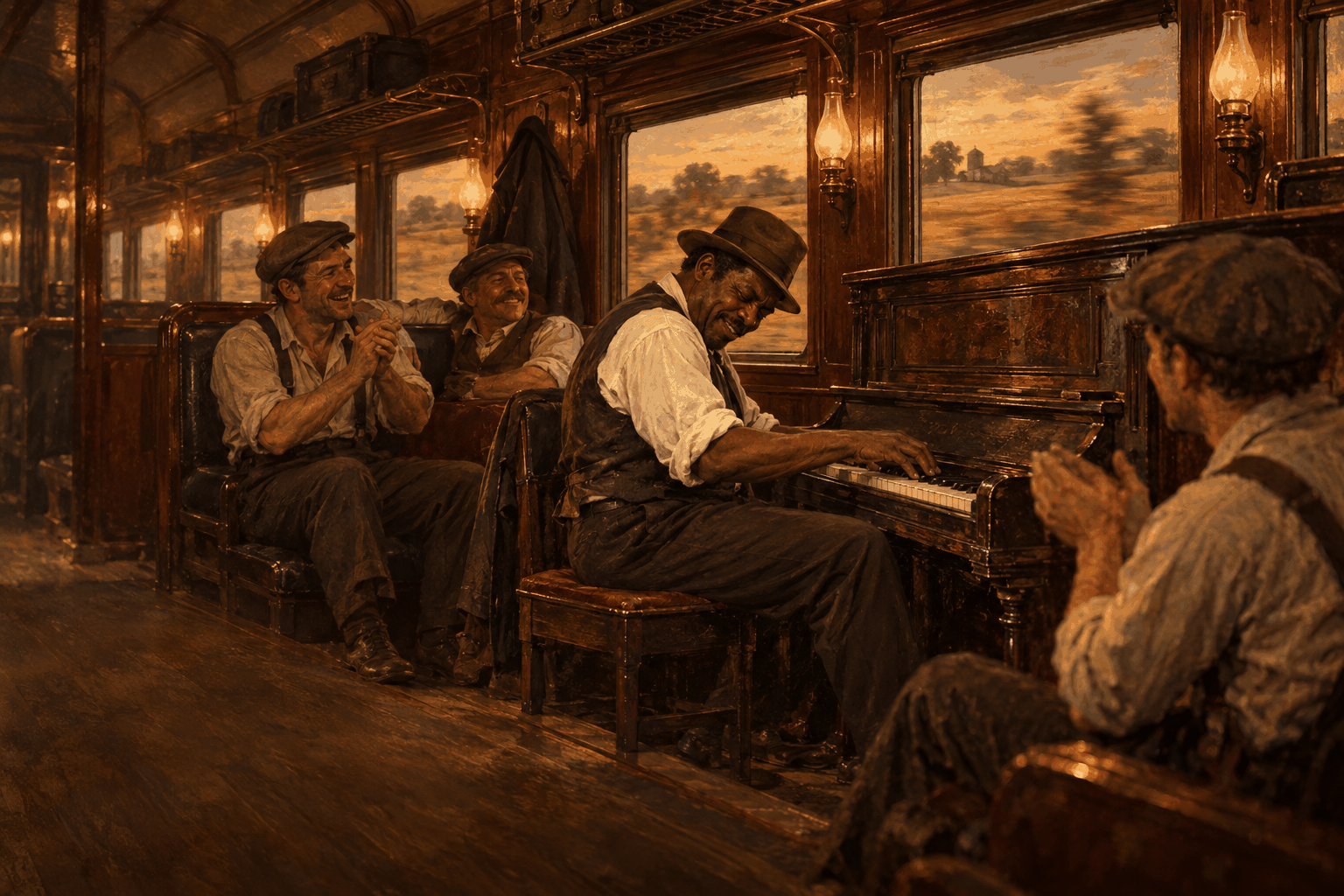
Another of the decisive factors was the train. During the First World War many workers migrated to the cities of the north, to Chicago in particular, and a number of trains were fitted out to carry those workers on their journeys to visit relatives.
Many of those carriages had pianos put inside them (they were christened "Honky Tonk Trains"), and so the music spread to every city where the trains stopped.
The importance of Boogie Woogie lies in the left hand, which keeps up a constant rhythm called "Eight-To-The-Bar" and with which its players could leave their right hand free to drink or eat without letting the music stop. Towards the middle of the 20's the record companies began to take an interest in these artists, and in 1928 Pine Top Smith recorded for Vocalion the first number with the word "Boogie" in it, "Pine Top's Boogie Woogie" — though a year earlier, in December 1927, Meade Lux Lewis had recorded "Honky Tonk Train Blues" for the Paramount label, on which he shows a very polished "Boogie" style. But it would not be until 1938, at the hands of John Hammond and his show "From Spirituals to Swing" with the artists later known as "The Boogie Woogie Trio" — Meade Lux Lewis, Albert Ammons and Pete Johnson — that Boogie spread across the country like a fever, the one known as the "Boogie Craze".
From then on every artist in the country put some Boogie in the repertoire, like Count Basie with "Basie's Boogie" or Tommy Dorsey with "Boogie Woogie"; and the Tin Pan Alley lyricists Don Raye and Hughie Prince bombarded the market with a run of numbers all in a Boogie key, "Scrub me mama with a boogie Beat", "Rhumboogie", "Boogie Woogie Bugle Boy", etc... That writing team was tied to the publisher Leeds Music, which handed the newly opened Capitol label its first hit in 1942, "Cow Cow Boogie" for Freddie Slack and Ella Mae Morse, and would hand them "Mr Five By Five" as well.
The Boogie fever reached labels such as Modern, which put out as its first record "Swingin' The Boogie" by Hadda Brooks in 1945.
After the Second World War its pull was such that even the Country artists came up with their own way of playing it, at the hands of figures of the stature of Merle Travis, Hank Penny, the Delmore Brothers and Bob Wills, in what would become "Country Boogie"...
Cholo