Recording Without a Recipe: Sun, RCA and J&M
The surviving accounts do not describe a single studio recipe behind these 1950s records. They describe specific solutions, in specific places, by named people.
The trade-paper issues examined for this article are not much help with studio technique. They review these records and chart them, and their columns deal in voices, impressions and market, not in how a session was run; the word `slapback` does not appear in the trade press sampled for this article at all. What survives instead is a mixture of participants' recollections, curatorial attributions and interviews, and each of those carries its evidence differently.
5 July 1954: a session in motion
The account used here of the 5 July 1954 Sun session is an essay written for the Library of Congress's National Recording Registry, and it describes people rather than equipment.
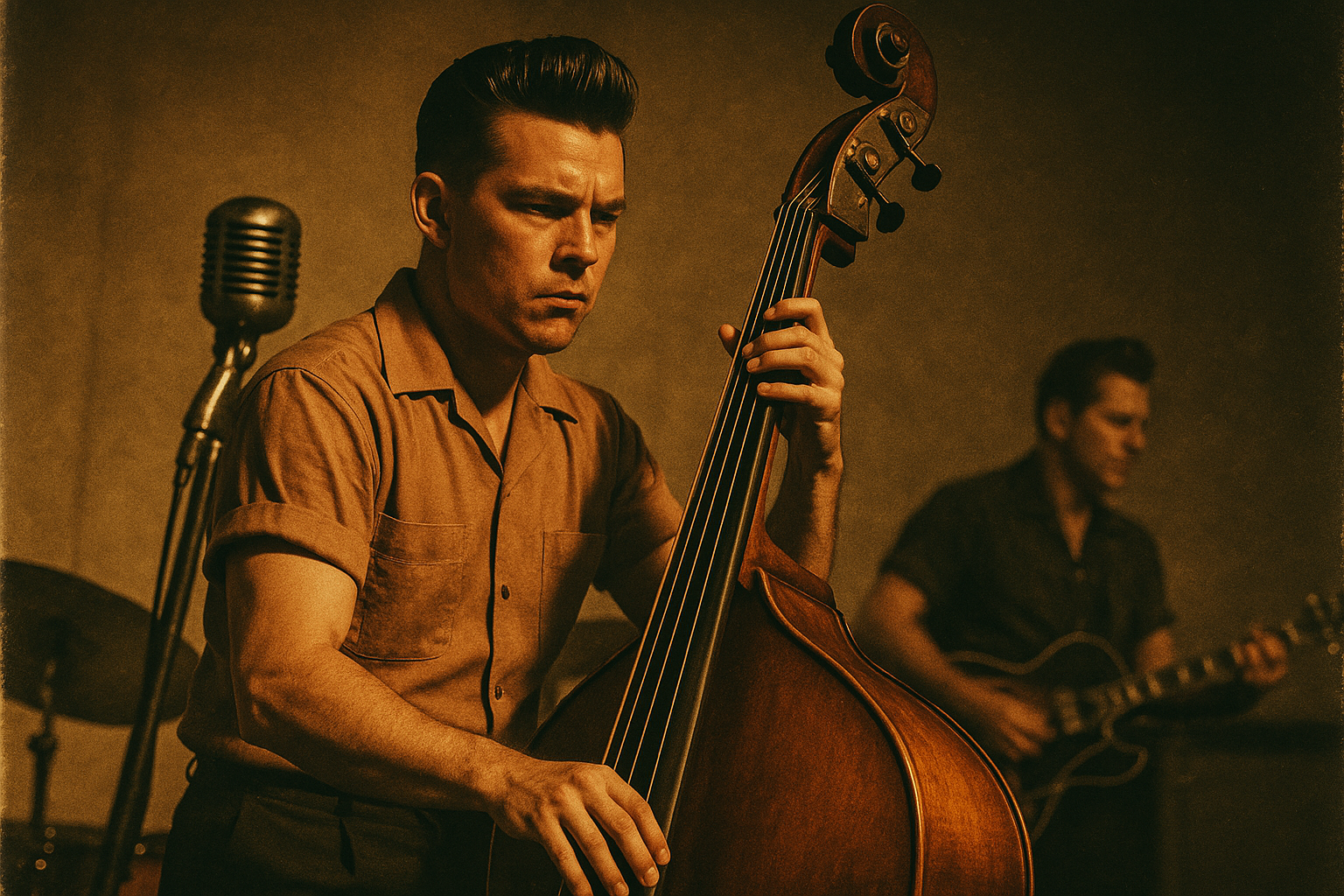
During a break, Elvis Presley started playing a blues song previously recorded by Arthur "Big Boy" Crudup. `Bill jumped up and started slapping his bass in time to the music. Then Scotty joined in on electric guitar.` Sam Phillips put his head round the control room door — `"Well, it didn't sound too bad through the doors," he said. "Try it again. Let me get in there and turn the mics on."`
What happened next is the only part of the process the essay sets out:
`They played the song several times while Sam adjusted the microphones, finally moving Elvis's microphone closer to his face. After they felt they had the song down pat, Sam started the tape recorder.`
Microphones, their placement, several passes before anything was committed, and then the tape. The essay does not mention echo anywhere. Whatever Phillips did to these recordings beyond this is not in the account of the session.
Sun: echo from tape
For that, the source is one of the men in the room. Interviewed by Terry Gross in 1997, Scotty Moore named the method Phillips used at Sun: `tape-delay echo`.
He did not describe how it was set up, and neither does anything else consulted here. A widely repeated explanation has Phillips running the tape through a second recorder head; the one place that account was found states at the foot of the page that its source is Wikipedia, so it is not reproduced here.
What can be added is the hardware, and it comes from a museum. When the Country Music Hall of Fame and Museum opened an exhibition on Phillips in 2015, its object list included an `RCA 76-D monaural radio mixing console and Ampex 350 console tape recorder Phillips used to create the classic "slapback" echo heard on Elvis Presley's Sun Record sessions.`
That is a curator attributing two machines to an effect, sixty years afterwards. It names equipment that Moore's recollection does not, and it stops there: neither source explains the signal path.
RCA: the same guitarist, another echo
After his contract moved to RCA Victor at the end of 1955, Presley was recording for a different company, with Scotty Moore again in the room, and the echo came from somewhere else entirely.
Moore, describing the making of Heartbreak Hotel, remembered the building: `they had this big long hallway out in front that had the tile floor. So they put a big speaker at one end of it, and a mike at the other end.`
He drew the contrast himself. What RCA got was `the deep, real-room echo instead of the tape-delay echo that Sam had used`.
Two methods, two companies, one artist, and one guitarist present for both.
J&M: the equipment changed, the listening came first
In New Orleans, Cosimo Matassa was recording at J&M. Interviewed for Tape Op in 2004, he described a working life measured in formats rather than effects: `I started off on disc`, then `a one track. Ampex`, and after that `I went from two to three, three to four and four to eight — and that's as far as I got.`
The constraint he returns to is inputs. `When I first started I was very limited in the number of inputs I had`, he said — and the example he gives is a piano, `a Baldwin. Middle size — seven footer`, recorded with one microphone: `What I would do is I would use one, either a 77B or a 44DX, and hang it over the soundboard try to find a place where everything was balanced.` That is a description of how he miked one instrument, not of how he balanced a band.
Later in the interview he describes a routing arrangement in which the three-input mixer from the Presto fed a line input on the portable mixer, with those three inputs normally used for the drums — effectively a drum submix. He describes working on two tracks, bouncing them and adding to the second machine, with the practical limit arriving around the second bounce as the noise built up.
What he does not describe is a house sound. Asked about one, his answer was flat: `The New Orleans Sound? There's no such thing.` He put the results down to the musicians and the atmosphere rather than to a studio formula, and said that the order of work mattered — that he listened to the players first and then went to the control room and tried to reproduce what he had heard outside it.
No single studio formula
Three studios, and what the sources document does not line up into a method.
`Tape-delay echo` belongs to Phillips, at Sun, in Moore's recollection of it. The `RCA 76-D` and the `Ampex 350` belong to a museum's attribution about those same sessions. The tiled hallway belongs to one record, Heartbreak Hotel, and not to RCA's practice in general. The routing, the bouncing and the order of listening belong to Matassa across years of work at J&M, and cannot be assigned to any particular record he made there.
None of it describes a technique that produced a genre. It describes people solving the problems in front of them, in rooms with different equipment in them, and in two of these cases for the same singer.
A note on sources
- Trade press. Billboard and Cash Box were searched in the World Radio History archive for the vocabulary of studio process. The term `slapback` returns nothing before the mid-1960s there, and the issues of 1954-56 read for this series describe records without describing how they were made. That is a statement about the archive and the issues examined, not about everything printed at the time.
- The Sun session. Sun Records Sessions — Elvis Presley (1954-1955), an essay for the National Recording Registry hosted by the Library of Congress. It is signed by James L. Dickerson, co-author of two books with Scotty Moore, and carries the Library's own notice that the views in it are the author's. It is used here for the session narrative only; it contains no reference to echo, tape delay or any equipment brand.
- Scotty Moore, interviewed by Terry Gross, Fresh Air, 29 July 1997. A participant recalling both sessions four decades later.
- Country Music Hall of Fame and Museum, press release of 25 August 2015 for the exhibition Flyin' Saucers Rock & Roll: The Cosmic Genius of Sam Phillips. A curatorial attribution of objects, not a document of the 1950s.
- Cosimo Matassa, interviewed by Craig Schumacher and Roger King, Tape Op no. 40, March 2004. The publicly visible portion of that page ends partway through the interview; the passages on the Presto mixer, the drum submix, the two-track bouncing and the "New Orleans Sound" come from the indexed text of that same page, and have not been checked against the printed issue.
- Not used: a widely cited page on a record label's own site describing Phillips's echo in detail, because it states at the foot that its source is Wikipedia.
- No source consulted explains the signal path of any of these echoes. None is reconstructed here.