Johnny Burnette: The Records That Failed and the Tour That Didn't
On 9 September 1956 the Rock and Roll Trio walked out at Madison Square Garden for the final of Ted Mack's Original Amateur Hour and played "Tear It Up" and "Hound Dog" to the largest audience of their lives. Almost nobody saw it. The broadcast went out against Elvis Presley's first appearance on the Ed Sullivan Show, which took 82.6 per cent of the American viewing audience that night.
That is the Rock and Roll Trio in one image: in exactly the right place, at exactly the wrong moment, playing music that would matter enormously about ten years later.
This article follows Johnny Burnette through both halves of his working life — the trio that failed commercially and the solo career that finally worked, in Britain, on a package tour of Granada cinemas. Both halves are below, date by date.
The trio, 1951-1957
Three Memphis boys who met at a boxing tournament: Johnny on vocals and rhythm guitar, his older brother Dorsey on double bass, and Paul Burlison on lead guitar. They played the Memphis clubs from the early fifties and held down a two-year residency at the Hideaway Club in Middleton, Tennessee, from February 1954 to February 1956, backed by the Doc MacQueen Swing Band and keeping day jobs throughout.
In early 1956, laid off from the Crown Electric Company — the firm that had employed Elvis Presley as a truck driver — they drove to New York through snowstorms and took rooms at the YMCA. They won three consecutive rounds of Ted Mack's televised talent contest that April and May, which got them a management deal, an agency and a contract with Coral Records.
Then they made the records. "Tear It Up". "The Train Kept A-Rollin'". "Honey Hush". "Lonesome Train". Burlison's guitar on those sides — a pinched, distorted, furious tone he got, by the usual account, from a loose valve in his amplifier — is one of the most imitated sounds in the music.
None of them charted. Three singles and one LP across 1956 and 1957, and not a single national hit. Dorsey walked out after a fight at a Niagara Falls date in the autumn of 1956 and was replaced by Johnny Black, brother of Elvis's bass player. By the autumn of 1957 the group was finished, worn down by one-nighters and the absence of any commercial return.
Two of their bookings can be dated exactly:
- 16 June 1956 — the Giant Rock 'n' Roll Revue at the Hippodrome, Cleveland, on a bill with Chuck Berry, Clyde McPhatter, Frankie Lymon and the Teenagers, Lonnie Donegan and the Jodimars.
- 9 September 1956 — the Ted Mack final at Madison Square Garden.
The summer of 1956 also put them on the Ted Mack touring package, a Carl Perkins package and a Gene Vincent tour. No itinerary survives for any of the three.
The Coral repertoire: "Tear It Up", "Honey Hush", "Lonesome Train" and seventeen more.
California, and the songs that paid
Johnny and Dorsey went west. Working from a Map to the Stars, they sat on Ricky Nelson's doorstep until he agreed to see them, and then wrote him "Believe What You Say", "It's Late" and "Waitin' in School". As the Burnette Brothers they cut "Warm Love" for Imperial in 1958; Coral issued "Blues Stay Away From Me" under the credit "Johnny and Dorsey Burnette" in 1960.
Johnny's own hits arrived in 1960 and they were not rockabilly. "Dreamin'" reached number 11 in America and number 5 in Britain. "You're Sixteen" went to 8 and 3. Both went gold. The man who had made "The Train Kept A-Rollin'" was now a teen balladeer, and that is what finally sold.
Britain bought it harder than America did.
Rock 'n' Twist U.S.A.: twenty-three nights, April and May 1962
In the spring of 1962 promoter George Cooper put Johnny Burnette on a package tour of Britain with Gary U.S. Bonds and Gene McDaniels. It ran twenty-three consecutive nights — no days off, not one — from Glasgow on 21 April to Walthamstow on 13 May, almost entirely in Granada cinemas.
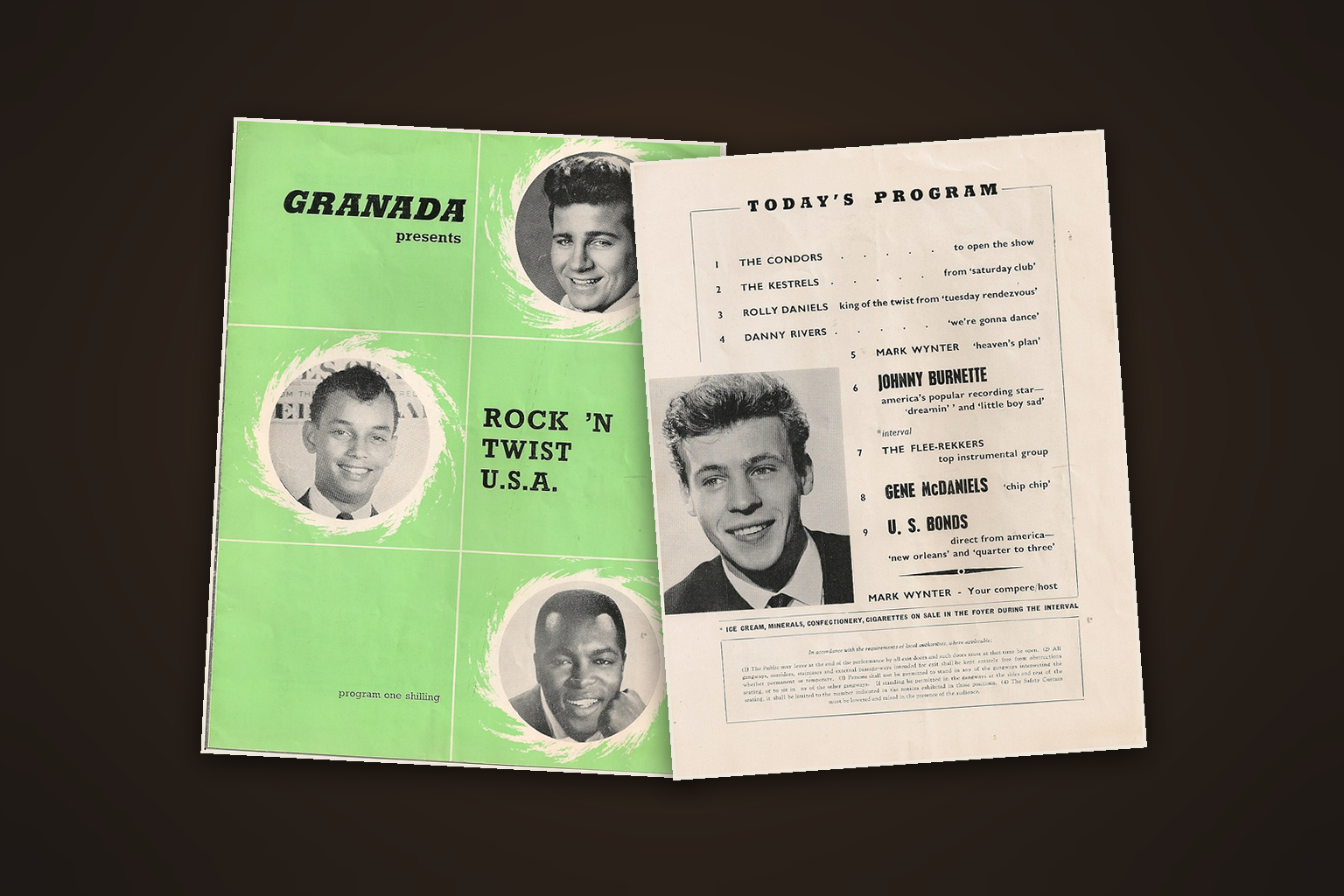
The souvenir programme survives. It cost a shilling, its cover is lime green with three circular photographs set in white brushstroke rings under the words GRANADA presents ROCK 'N TWIST U.S.A., and inside it prints the running order:
- 1. The Condors — to open the show
- 2. The Kestrels — from 'Saturday Club'
- 3. Rolly Daniels — king of the twist from 'Tuesday Rendezvous'
- 4. Danny Rivers — 'We're Gonna Dance'
- 5. Mark Wynter — 'Heaven's Plan'
- 6. JOHNNY BURNETTE — america's popular recording star, 'Dreamin'' and 'Little Boy Sad'
- interval
- 7. The Flee-Rekkers — top instrumental group
- 8. Gene McDaniels — 'Chip Chip'
- 9. U.S. Bonds — direct from america, 'New Orleans' and 'Quarter to Three'
Mark Wynter was the compere as well as the fifth act.
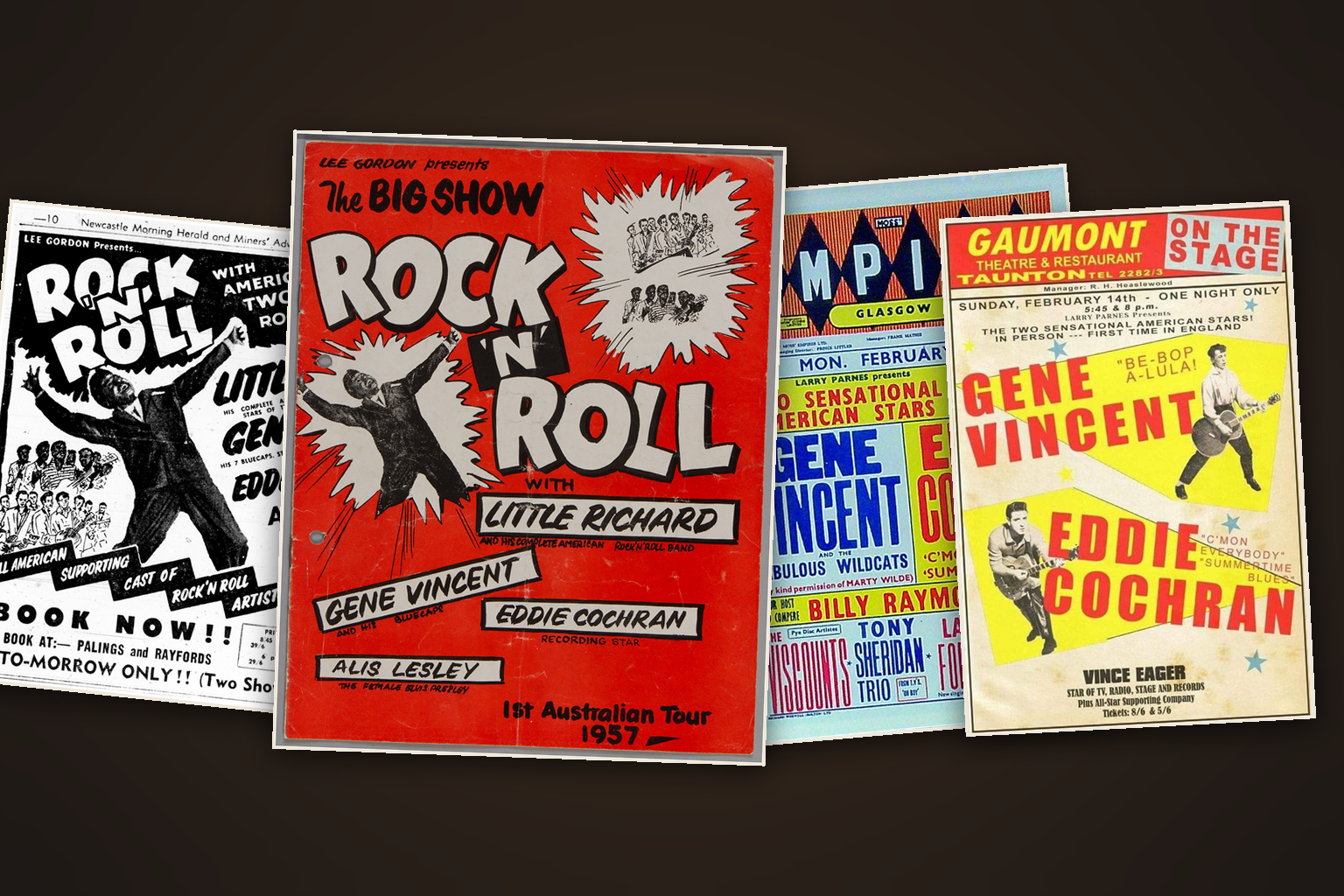
Note where Burnette sits: closing the first half. That is precisely the slot Eddie Cochran had occupied on the same British circuit two years earlier, on Larry Parnes' Anglo-American Beat Show — American, hit-carrying, big enough to send the audience to the bar happy and not big enough to close the show. The British package tour had a shape, and both men were slotted into the same place in it.
The itinerary
- 21 April — St Andrew's Hall, Glasgow. Opening night.
- 22 April — Hippodrome, Birmingham.
- 23 April — Guildhall, Portsmouth.
- 24 April — De Montfort Hall, Leicester.
- 25 April — Gaumont, Doncaster.
- 26 April — Gaumont, Worcester.
- 27 April — Colston Hall, Bristol.
- 28 April — Winter Gardens, Bournemouth.
- 29 April — Granada, Rugby.
- 30 April — Granada, Dartford.
- 1 May — Granada, Aylesbury.
- 2 May — Granada, Kingston.
- 3 May — Granada, Harrow.
- 4 May — Granada, Grantham.
- 5 May — Granada, Mansfield.
- 6 May — Granada, Tooting.
- 7 May — ABC, Plymouth.
- 8 May — Granada, Maidstone.
- 9 May — Granada, Bedford.
- 10 May — Granada, Kettering.
- 11 May — Granada, Woolwich.
- 12 May — Adelphi, Slough.
- 13 May — Granada, Walthamstow. Closing night.
Read that list as a working diary rather than a schedule. Grantham on the Friday, Mansfield on the Saturday, Tooting on the Sunday, Plymouth on the Monday: that is Lincolnshire to Nottinghamshire to south London to Devon on four consecutive nights, in 1962, by road.
Burnette also toured Australia with Connie Francis around this period; no itinerary for it survives.
Two years later
On 14 August 1964 Johnny Burnette was fishing on Clear Lake, California in an unlit boat when a cabin cruiser struck it. He was thrown into the water and drowned. He was 30.
Dorsey turned to country music, placed fifteen singles on the country chart in the 1970s and died of a heart attack in 1979, aged 46. Paul Burlison went back to Memphis, left music entirely when the trio broke up, and stayed away for a quarter of a century.
The name kept working without them
Burlison recreated the Rock and Roll Trio in the early 1980s with Johnny Black and Tony Austin, and Johnny's son Rocky Burnette fronted it on occasion. Bookings under the Burnette name therefore continue for decades after both brothers are dead, and they are not the same act:
- 6 November 1981 — Caister. The souvenir programme billed it as "The Johnny Burnette Trio with Rocky Burnette", alongside Frankie Ford and the Deltas.
- 8 October 2000 — Hemsby #25, billed as the Johnny Burnette Rock 'n' Roll Trio. Burlison was alive and working until 2003, but who was on stage that night is not documented.
What we still want
- Any dated handbill, advertisement or ticket from the trio's 1956 package tours with Ted Mack, Carl Perkins or Gene Vincent.
- The personnel of the Hemsby #25 booking in October 2000.
- Anything at all from the Australian tour with Connie Francis.