
Gals From the Hills: Billboard's 1953 Search for Country Women Singers
The front page of Billboard for 20 June 1953 carries a story under the kicker `GALS FROM THE HILLS` and the headline:
`Kitty & Goldie Start Country-Girl Search`
The opening sentence explains the business logic without any decoration:
`NEW YORK, June 13. — Ever since Kitty Wells hit with a big-selling disk on "It Wasn't God Who Made Honky Tonk Angels" and Goldie Hill followed with "I Let the Stars Get in My Eyes," diskery a.&r. men have been scouring the hinterlands for additional girl country singers in hopes of coming up with one to rival the sales racked up by the two Decca artists.`
Two country records by women had sold. The labels went looking for additional women country singers.
What the search had turned up by that week
The story continues inside, on page 19, under a second headline — `A.&R. Men Search For Fem Hillbillies` — and the continuation is a roll-call. It is worth reading as the trade paper printed it, label by label:
`Line-up of some recent additions to country rosters include Charlene Arthur, Joyce Moore, Sunshine Ruby, Davis Sisters and Betty Cody on RCA Victor; Jeanette Hicks, Rose Maddox, Molly O'Day, Polly Possum and Cindy Walker on Columbia; Marge Collie and three to be introduced in September on Decca and Little Rita on M-G-M.`
`RCA Victor also records Miss Allen and Dale Evans, while Columbia has the Carter Sisters and Mother Maybelle, Daisy Mae, Betty Johnson and Wilma Lee. Capitol boasts of Martha Carson on sacred tunes and Margaret Whiting, who has broken thru several times in duets with [Jimmy] Wakely. King has Ann Jones, Bonnie Lou and others.`
That is more than twenty names and acts in a single continuation column, across six labels, in one week of 1953. The vocabulary — `gals`, `fem hillbillies`, `girl singers`, `thrushes` — is the paper's own, and it is quoted here as such.
Billboard is careful about how far it will go: `While the recording execs are not yet willing to predict a major trend toward girl singers in the country market, they all agree that the spark lit by Misses Wells and Hill seems to have fired some additional enthusiasm for the fem singers.`
How they got there
The same page is equally frank about the route in, and it is not a story of open doors:
`The girls, incidentally, rarely get on wax from "out of the blue" — as is fairly common in the pop field.`
The examples it gives involve existing personal ties or established professional careers. Marge Collie is identified as the wife of a disc jockey and recording artist, and previously married to Floyd Tillman. Betty Cody is the wife of Lone Pine and had recorded duets with him. Cindy Walker, new to Columbia, was already `a prolific writer of country tunes`.
And Rose Maddox, the paper notes, `had been working as part of the Maddox Brothers and Rose for some time before Columbia decided to try her as a single artist` . The booklet Chris Strachwitz wrote for Arhoolie's reissue of that band's early sides lists her as `Rose Maddox - lead vocals` in a group that had been on California radio since 1937 — sixteen years before Columbia tried her as a single artist.
Elsewhere in the same June 1953 issue, a review: `COLUMBIA 21127 — Rose Maddox delivers a very strong performance…`
Before the search: the charts of 1948
The 1953 story is specifically about a renewed search for women in the country market. Five years earlier, in a different trade category, the charts looked like this.
Billboard of 1 May 1948, page 30, lists `MOST-PLAYED JUKE BOX RACE RECORDS`. At number two: Nellie Lutcher, Fine Brown Frame, `Capitol 15032` — above Louis Jordan's two entries that week. On another page of the same issue, in the album listings, a `Nellie Lutcher Album` on `Capitol CC-72` sits beside Peggy Lee's on `Capitol CC-70`.
A different category and a different chart, five years before the search that made the front page.
Around the same pages, 1953-1957
The women in these years are not confined to one list.
Ruth Brown appears in the rhythm and blues territorial listings of that same 20 June 1953 issue with `Atlantic 993`, printed alongside a B. B. King release. Willie Mae Thornton turns up in Cash Box of 15 May 1954, where a column reports that `the new Willie Mae Thornton "I Smell A Rat"` had `started to take hold very quickly`.
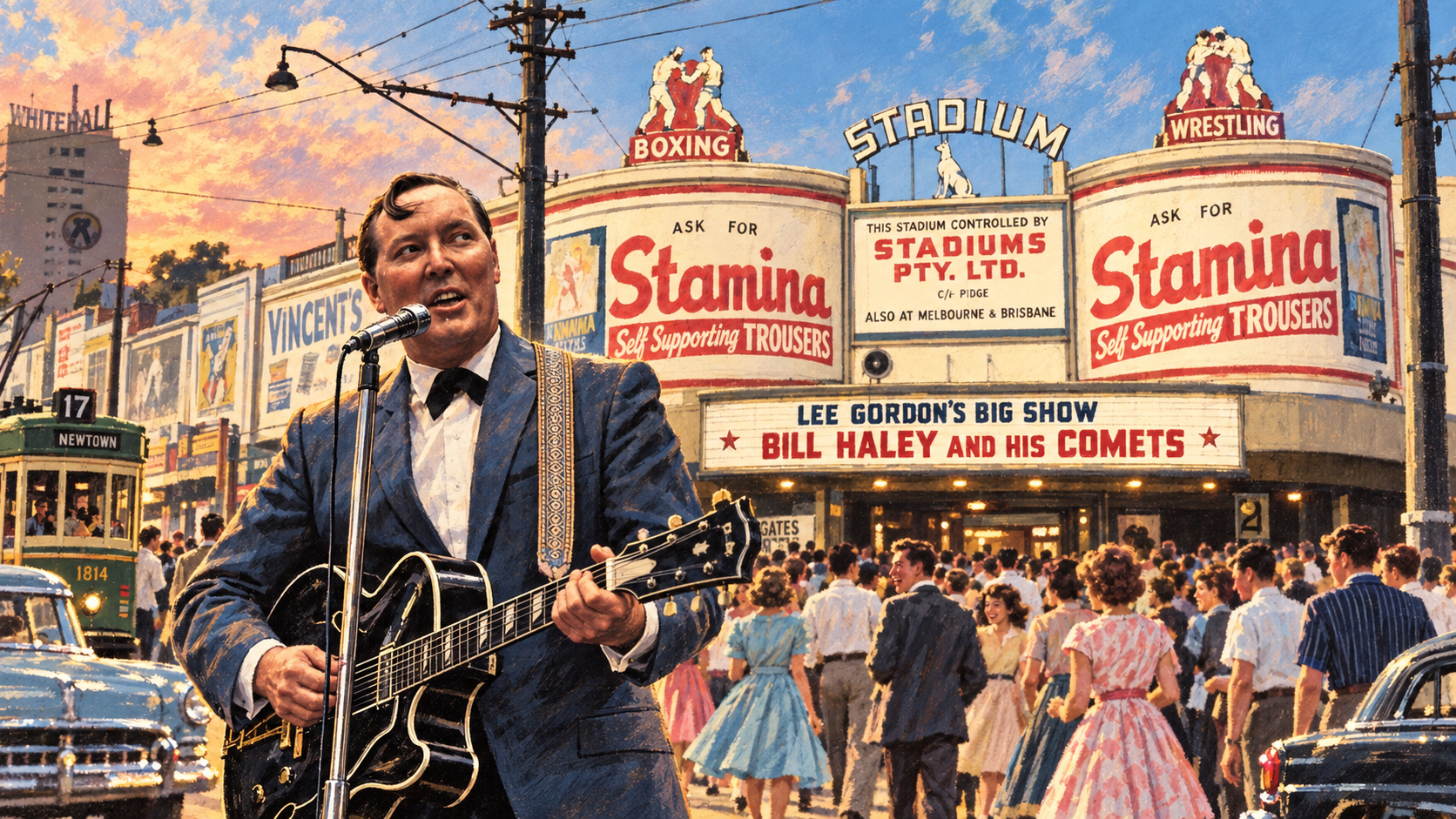
LaVern Baker was advertised in Brisbane's Telegraph on 7 January 1957 appearing `with Bill Haley and his Comets at the Stadium on Wednesday and Thursday nights` — part of the Australian package that took Haley across the country. Later that year, on Lee Gordon's October tour, the printed programme gave Alis Lesley a strapline of her own: `ALIS LESLEY — the female Elvis Presley`.
And by the summer of 1956 the trade papers were handing out categories as well as chart positions. Cash Box of 28 July 1956 reports that Wanda Jackson `copped top honors as the 'most promising up and coming female vocalist'`; a few columns away, the same issue has her leaving for a tour of Alaska, and notes `RCA Victor's` Janis Martin appearing as a guest on a disc jockey's record roundup.
What the pages show, and what they do not
They show a woman at number two on a race chart in 1948, on country and rhythm and blues rosters and listings in 1953, on an international package bill in 1957, and winning a poll category in 1956 — with catalogue numbers attached to most of it.
They also show an industry that in 1953 was looking for more of them because two records had sold, that would not call it a trend, and that said women rarely arrived `out of the blue`, illustrating the point with several existing personal or professional ties.
What these pages do not contain is any account of what these singers did musically — the phrasing, the timing, the delivery. These trade columns deal in sales, bookings and categories. A history of how they sang would need a different kind of source than the ones quoted here.
A note on sources
- The 1953 talent search. Billboard, 20 June 1953: front page, `GALS FROM THE HILLS — Kitty & Goldie Start Country-Girl Search`, continued on page 19 as `A.&R. Men Search For Fem Hillbillies`. The roll-call, the caution about a trend and the remark about how singers reached a label are all from that continuation.
- Period terminology. `Gals`, `fem hillbillies`, `girl singers` and `thrushes` are the trade press's own words of 1953, quoted and dated. They are not used here as description.
- Other trade press. Billboard of 1 May 1948 for the race chart and album listings; of 20 June 1953 for the Ruth Brown listing and the Rose Maddox review. Cash Box of 15 May 1954 for Willie Mae Thornton and of 28 July 1956 for Wanda Jackson and Janis Martin. Facsimiles from the World Radio History archive; page numbers are pages of the facsimile.
- Rose Maddox before Columbia. Booklet by Chris Strachwitz for the Arhoolie reissue The Maddox Brothers & Rose, Vol. 1, hosted by Smithsonian Folkways, for the band's radio work from 1937 and for the personnel listing.
- The 1957 bills. Brisbane's Telegraph of 7 January 1957, from the National Library of Australia's Trove collection; and the Lee Gordon tour programme The Big Show — Rock 'n' Roll, 1st Australian Tour 1957.
- Several names in the 1953 roll-call appear there and nowhere else in the material quoted above. They are reproduced because the list is the document, not because each career has been traced here.