Bill Haley in 1957: The Big Show and Britain's Changing Tour Circuits
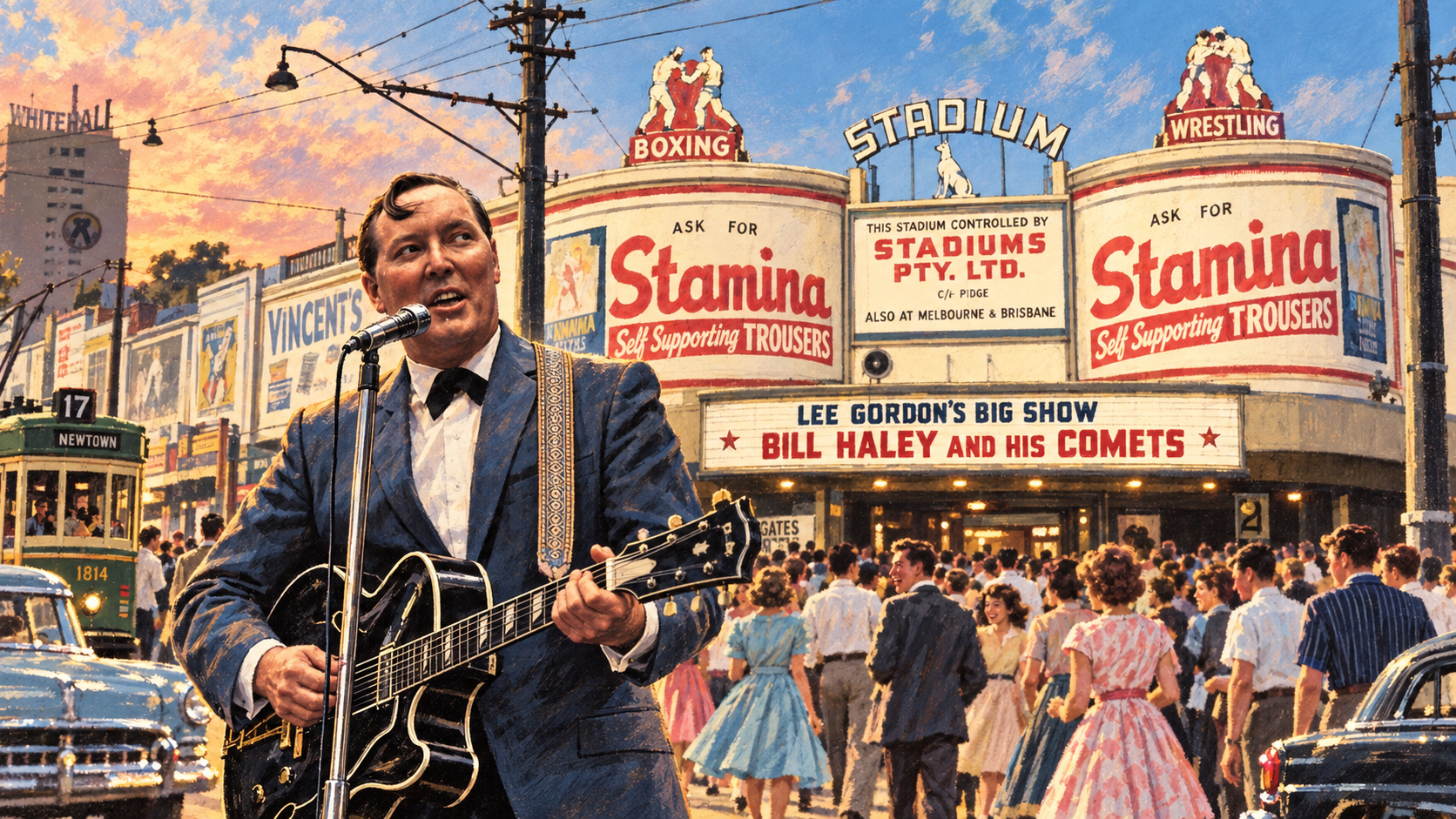
In January 1957 Bill Haley and the Comets crossed Australia at the top of a Lee Gordon package that the advertising called, in capitals and quotation marks, The "BIG SHOW". Eleven days after the last Sydney date he opened at the Dominion Theatre on Tottenham Court Road.
The British itinerary is reproduced below. For Australia, the contemporary press fixes part of the route.
Why Britain, and why 1957
American bands had been kept out of British variety halls for a generation, and the mechanism is documented. In their history of the British Musicians' Union, Martin Cloonan and Matt Brennan trace it to a Ministry of Labour press communiqué of 29 March 1935, after which permits for American bands stopped being granted freely.
The route back was a reciprocal exchange agreement, reached in 1955. The union's own Executive Report for 1957 records the result: "between March and May 1956, Stan Kenton and his Orchestra performed in Britain and Ted Heath and his Orchestra performed in the USA". Ten similar exchanges followed. Cloonan and Brennan date the relaxation precisely to 1955.
So Haley arrived in February 1957 within two years of that agreement, under the reciprocal exchange system introduced in 1955. That helps explain why an American rock and roll package did not reach Britain until 1957.
"Rock Around the Clock", before and after
He was thirty-one that winter, a former western swing bandleader with a kiss curl and a band of grown men in tartan jackets, and the record that carried him had taken an unusual route.
"Rock Around the Clock" was cut at the Pythian Temple in New York on 12 April 1954 and issued that May as the B-side of "Thirteen Women (And Only One Man In Town)". It was treated as a commercial disappointment, though it did reach the American charts. A year later it was used under the opening credits of Blackboard Jungle, and on 9 July 1955 it reached the top of Billboard's pop chart, where it stayed for eight weeks.
The song had not failed in 1954. It had done what a modest hit does, and then the film gave it a second life.
January 1957: Lee Gordon's BIG SHOW
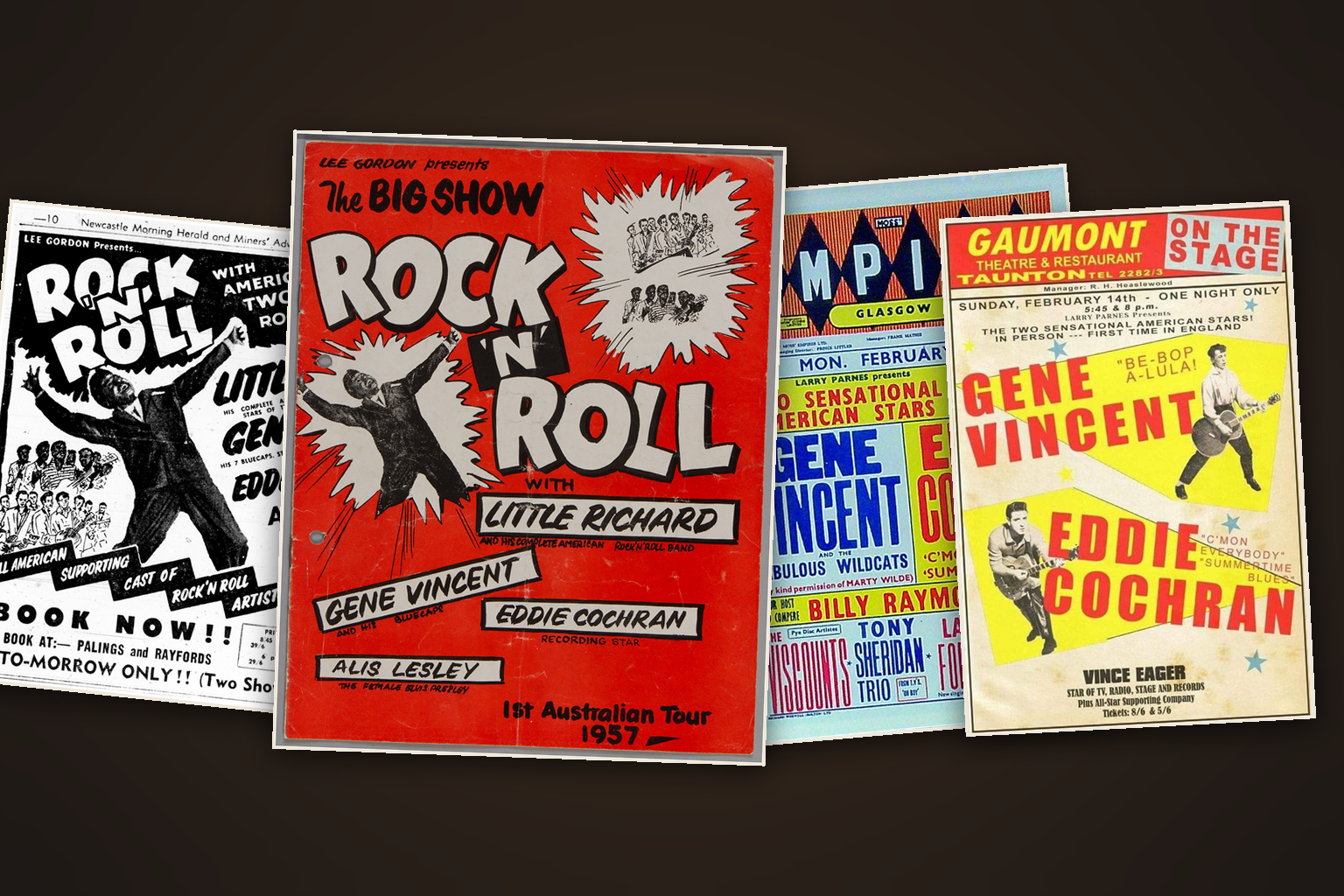
The Brisbane Telegraph carried the advertising through the first week of January: LEE GORDON PRESENTS In PERSON Bill Haley and His COMETS, and along the foot, THE BIG SHOW. Seats at 39/6, 29/6 and 19/-, booking at Palings, curtain at 8.45.
It was not a four-man act on tour. The Argus of Melbourne, on 12 January, wrote that Haley "heads a line-up of 22 American artists". On the bill with him were LaVern Baker, Big Joe Turner — whose "Shake, Rattle and Roll" Haley had covered, and who was now standing on the same stage — and Freddie Bell and the Bell Boys. Al Rex appears in the Northern Territory News as one of the Comets.
The Platters were in the country at the same time, and in the same city. The Telegraph of 10 January has them "currently playing Brisbane", on the nights Haley was at the Stadium there, and the Mount Isa Mail of 17 January describes them as "now making an Australian tour". The surviving advertising sheet for Haley's package names four acts and not them.
The arrivals made copy of their own. Two hundred people met the plane at Adelaide airport. In Brisbane a police chief had to get Haley away from a crowd outside a party. And the Australian Women's Weekly sent Helen Frizell, who filed twelve hundred words under the headline "Please! no riots," says American rock-'n-roll king and described Brisbane Stadium packed to hear the Comets "in the 'Big Show'".
Where the press puts them
Three of the Australian engagements can be read in the papers of the week.
- Brisbane Stadium, Wednesday 9 and Thursday 10 January. The Telegraph of 7 January has LaVern Baker appearing `with Bill Haley and his Comets at the Stadium on Wednesday and Thursday nights`, and the Toowoomba Chronicle of the 9th advertises a special bus to `BILL HALEY'S COMET ROCK 'N ROLL SHOW, BRISBANE STADIUM, This Wed. 5.30 p.m.`
- West Melbourne Stadium, from 14 January. The Argus of that Monday advertises `THE BIG SHOW, West Melbourne STADIUM`, and the same advertisement has tickets for the following week already on sale, so the company was booked back into the same building.
- Sydney Stadium, where both the Northern Territory News of 24 January and the Australian Women's Weekly of the 30th place the show.
Gordon had been using the name before Haley arrived: The Argus was advertising `THE BIG SHOW` at the same West Melbourne stadium in October 1956. And he kept using the pattern afterwards, with the printed titles changing as the music did: Little Richard, Gene Vincent and Eddie Cochran that October under The BIG SHOW ROCK 'N' ROLL, then Duane Eddy and Crash Craddock in January 1960, billed as The All-American ROCK SPECTACULAR!
February and March 1957: Britain
The Comets came off the Queen Elizabeth at Southampton on 5 February, having sailed rather than flown.
The tour ran from 6 February to 10 March, opening and closing at the Dominion, and took in twenty-three engagements across England, Scotland, Wales and Northern Ireland.
The British itinerary
- 6-9 February — Dominion Theatre, London.
- 10 February — Gaumont, Coventry.
- 11 February — Odeon, Nottingham.
- 12 February — Odeon, Birmingham.
- 13 February — Odeon, Manchester.
- 14 February — Odeon, Leeds.
- 15 February — Odeon, Sunderland.
- 16 February — Odeon, Newcastle upon Tyne.
- 17 February — Odeon, Bradford.
- 18-19 February — Odeon, Glasgow.
- 20 February — Odeon, Liverpool.
- 21 February — Capitol, Cardiff.
- 22 February — Odeon, Plymouth.
- 23 February — Gaumont, Southampton.
- 24-26 February — Gaumont State, Kilburn, London.
- 1-2 March — Hippodrome, Belfast.
- 3 March — Regal, Edmonton, London.
- 4-5 March — Davis Theatre, Croydon.
- 6 March — Carlton, Norwich.
- 7 March — Gaumont, Doncaster.
- 8 March — Gaumont, Wolverhampton.
- 9 March — Gaumont, Cheltenham.
- 10 March — Dominion Theatre, London. Closing night.
Read the venue names rather than the towns. Nine consecutive engagements, from Nottingham through to Liverpool, were Odeons; Gaumonts recur later, at Southampton, Kilburn, Doncaster, Wolverhampton and Cheltenham.
Not one circuit
The American tours that followed did not simply inherit those buildings, and the itineraries show it.
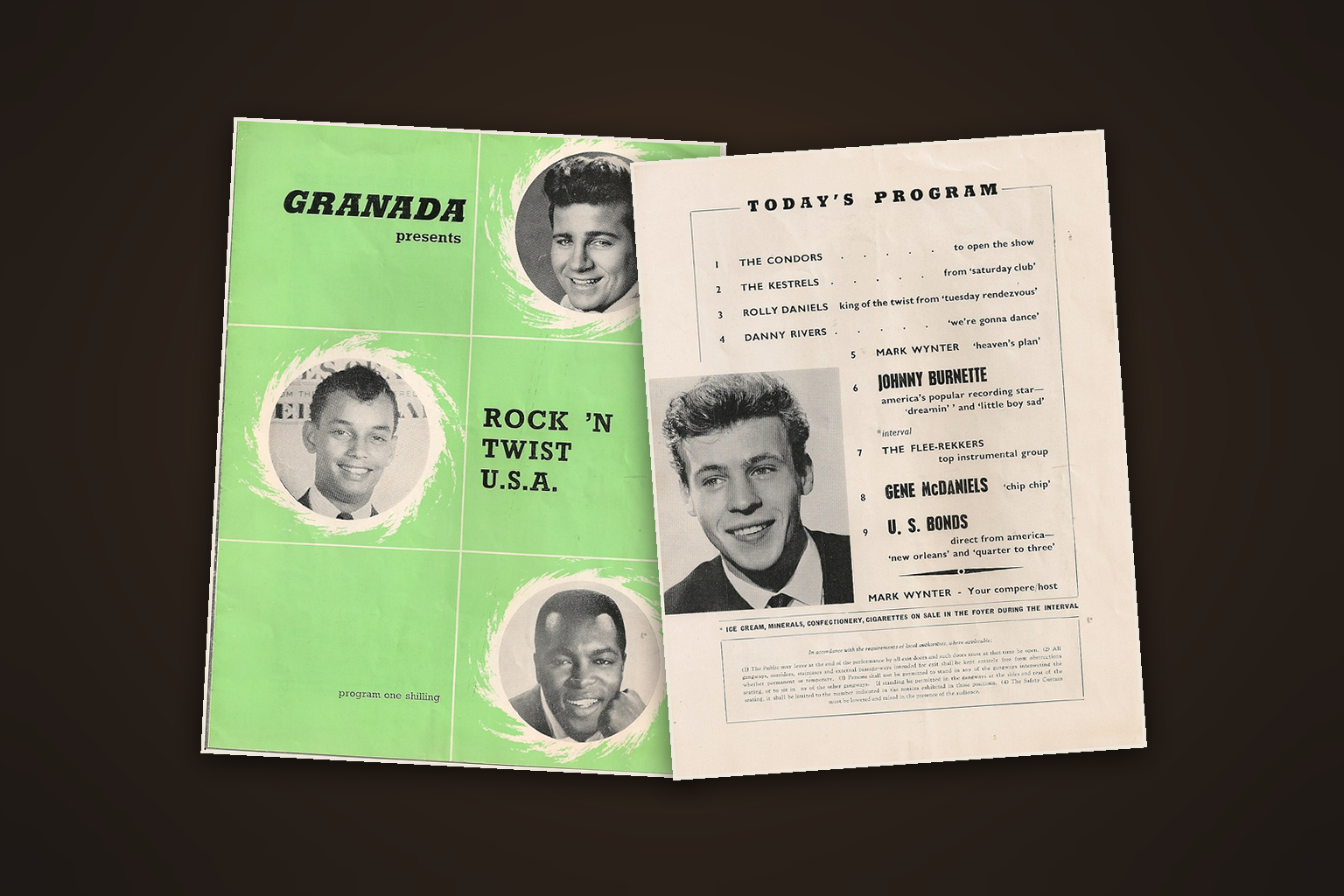
Set Haley's 1957 route beside Cochran and Vincent's of 1960, Duane Eddy's of the same spring and Johnny Burnette's of 1962, and in the biggest cities the later bills are working somewhere else entirely:
- Glasgow — Haley at the Odeon; Cochran and Eddy at the Empire; Burnette at St Andrew's Hall.
- Liverpool — Haley at the Odeon; Cochran and Eddy at the Empire.
- Birmingham — Haley at the Odeon; Cochran, Eddy and Burnette at the Hippodrome.
- Newcastle — Haley at the Odeon; Cochran at the Empire; Eddy at the City Hall.
- Cardiff, Southampton, Bradford, Plymouth, London — different buildings every time.
Haley's route was dominated by Odeons and Gaumonts. Larry Parnes, three years later, was working Empires and Hippodromes.
Six rooms do carry over, and they are worth naming because they are the real continuity:
- Gaumont, Coventry — Haley on 10 February 1957, Cochran on 28 January 1960.
- Odeon, Manchester — Haley on 13 February 1957, Eddy on 8 April 1960.
- Odeon, Leeds — Haley on 14 February 1957, Eddy on 6 April 1960.
- Regal, Edmonton — Haley on 3 March 1957, Eddy on 19 March 1960.
- Gaumont, Doncaster — Haley on 7 March 1957, Burnette on 25 April 1962.
- Gaumont, Cheltenham — Haley on 9 March 1957, Eddy on 17 April 1960.
Six of the twenty-two distinct venues reappear in the three later itineraries compared here. The other sixteen do not.
A note on sources
- Martin Cloonan and Matt Brennan, "Alien invasions: the British Musicians' Union and foreign musicians", Popular Music 32/2 (Cambridge University Press, 2013), pp. 277-295 — for the 1935 communiqué, the 1955 exchange agreement and the Kenton and Heath exchanges of 1956, quoting the union's Executive Reports.
- Contemporary Australian newspapers, from the National Library of Australia's Trove collection: Brisbane's Telegraph of 7, 8, 9, 10 and 17 January 1957 for the advertising, the billing, the prices, the Brisbane nights and the Platters in Brisbane; the Toowoomba Chronicle and Darling Downs Gazette of 9 January 1957 for the Brisbane Stadium advertisement; The Argus of Melbourne of 12, 14 and 19 January 1957 for the twenty-two performers, the Adelaide airport reception, Freddie Bell and the West Melbourne advertising, and of 6 October 1956 for `THE BIG SHOW` at the same stadium before Haley; the Mount Isa Mail of 17 January 1957 for the Platters on tour; the Northern Territory News of 24 January 1957 for Al Rex and Sydney Stadium; and The Australian Women's Weekly of 23 January 1957, page 20, for Helen Frizell's report, and of 30 January 1957 for the Sydney Stadium show.
- American Rock n Roll — The UK Tours, `http://www.americanrocknrolluktours.co.uk/`, which draws on the book American Rock n Roll — The UK Tours 1956-1972 — for the twenty-three British engagements. The same source underwrites the 1960 and 1962 itineraries used in the comparison above.
- Wikipedia, Rock Around the Clock, `https://en.wikipedia.org/wiki/Rock_Around_the_Clock` — a tertiary source, for the Pythian Temple session of 12 April 1954, the B-side release that May, the record's reception in 1954 and the run at the top of the Billboard pop chart from 9 July 1955.
- The size of the Southampton crowd, and the phrase "the Second Battle of Waterloo" attached to the Waterloo station arrival, are repeated consistently in secondary accounts without citation. Neither is given here as a figure or as a quotation.
- The named contemporary sources above document Brisbane, West Melbourne and Sydney. The remaining Australian dates are not reproduced here.