Johnny Burnette: Twenty-Three Nights, April and May 1962
In the spring of 1962 Johnny Burnette worked twenty-three consecutive nights across Britain, closing the first half of a touring package. Six years earlier, with his brother and Paul Burlison, he had cut a run of Coral sides that never reached the British chart.
The trio, 1949-1957
The Burnette brothers were boxers before they were a band. Both were Golden Gloves champions in Memphis, and in 1949 Dorsey met Paul Burlison, another Golden Gloves champion, at an amateur tournament in the city. Johnny and Dorsey were brothers; Burlison was the one the ring brought in.
From 1954 until February 1956 they played the Hideaway Club in Middleton, Tennessee, with the Doc MacQueen Swing Band. They kept day jobs: Burlison and Dorsey worked for the Crown Electric Company, as journeyman and apprentice electrician, the same firm that had employed Elvis Presley as a truck driver. Both were laid off in February or March of 1956.
They had already made a record before any of this paid off: `You're Undecided` backed with `Go Mule Go`, on the small Von label.
Then they drove to New York and took rooms at the YMCA. The day jobs went with them — Burlison and Dorsey worked as electricians, Johnny in the garment district — while they auditioned for Ted Mack's Original Amateur Hour and won three consecutive appearances in April and May 1956. Henry Jerome secured them an agency, GAC, and a contract with the Coral division of Decca.
On 9 September 1956 they appeared in the final of the Amateur Hour at Madison Square Garden, where, among other songs, they played "Tear It Up" and "Hound Dog".
The records
The first Coral session was at the Pythian Temple on 7 May 1956: "Midnight Train", "Oh Baby Babe", "Tear It Up", and a recut of "You're Undecided". Further sessions followed in July 1956 at Owen Bradley's studio in Nashville, and the album followed in December 1956, twelve tracks.
The accounts of how Burlison got his guitar tone on those sides differ. One has a valve working loose inside his amplifier. The other, in print, has the producer Bob Thiele telling him to turn up the treble on the amp, and out coming the pinched, stinging tone. The distorted sound is audible on the records; how it was produced is disputed.
None of it charted in Britain: no Rock and Roll Trio single reached the listings.
Who was actually on stage
The name says three. The touring party did not always. Tony Austin, a cousin of Carl Perkins, played drums with the group on many dates after the recording contract, so "trio" describes the billing and the studio rather than what audiences saw.
How it ended, twice over
Dorsey left in 1956, and the accounts of when and why do not agree. One has it that the brothers' quarrels came to a head at a date in Niagara Falls in the autumn of 1956, where Dorsey quit after a fight; he was replaced by Johnny Black, brother of Elvis's bass player. Rocky Burnette, Johnny's son, tells it differently: that Dorsey walked out a week before the group was due to appear in Alan Freed's film Rock, Rock, Rock!, and says nothing of Niagara Falls.
By the autumn of 1957 the group had split up.
On 16 June 1956 they played the Giant Rock 'n' Roll Revue at the Hippodrome in Cleveland, on a bill with Chuck Berry, Clyde McPhatter, Frankie Lymon and the Teenagers, Lonnie Donegan and the Jodimars. And there was the Ted Mack final of 9 September 1956.
Some of the Coral repertoire: "Tear It Up", "Honey Hush" and "Lonesome Train".
California, and the songs that paid
Johnny followed Dorsey west. The brothers went looking for Ricky Nelson with a map to the stars, and by Rocky Burnette's account Harriet Nelson told them the boys were at the gym, so the pair waited on the front lawn until Ricky came home, and then played him their songs.
Which songs is not settled. Rocky names "Believe What You Say", "It's Late" and "Just A Little Too Much"; "Waitin' in School" is elsewhere attached to the same story. What is clear is that the doorstep audition and the songwriting catalogue are two different questions: Rocky puts the number of Burnette songs Nelson eventually recorded at twenty-seven.
As the Burnette Brothers they cut "Warm Love" for Imperial in 1958, and Coral issued "Blues Stay Away From Me" under the credit "Johnny and Dorsey Burnette" in 1960.
Johnny's own hits arrived in 1960, and they were not rockabilly. In Britain he put five singles into the chart: "Dreamin'" at 5 in October 1960, "You're Sixteen" at 3 in January 1961, "Little Boy Sad" at 12 in April 1961, "Girls" at 37 that August, and "Clown Shoes" at 35 in May 1962.
Australia, April 1961
Before Britain there was Australia, and a tour the Australian press of the day called a Big Show.
Contemporary Australian newspapers carry the bill: Connie Francis heading, and with her, in the Telegraph of Brisbane's words, "other top artists Johnny Burnette, Bobby Vee, The Ventures, Donnie Brooks and Col Joye". They also carry his Australian calling card — "Johnny Burnette's hit of the moment is Little Boy Sad" — and the arrival: on Monday 24 April 1961 the wires reported Francis and Burnette mobbed by teenage girls at Sydney airport.
One night is documented in the advertising itself: Festival Hall, Brisbane, Thursday 27 April 1961, trailed in the Brisbane Telegraph all through the preceding week, with a competition offering readers free double passes.
Later compiled itineraries place the package in Melbourne on 25 April, Adelaide on the 26th and Sydney Stadium on the 28th and 29th.
Rock 'n' Twist U.S.A.: twenty-three nights
In April 1962 the promoter George Cooper put Burnette on a British package with Gary U.S. Bonds and Gene McDaniels. It ran twenty-three consecutive nights, without a day off, from Glasgow on 21 April to Walthamstow on 13 May.
A published survey of American tours of Britain sets out all twenty-three dates and venues, while the souvenir programme preserves the running order — and between them they record something the running order alone would hide: the Flee-Rekkers backed all twenty-three nights, as well as taking their own spot after the interval.
The programme
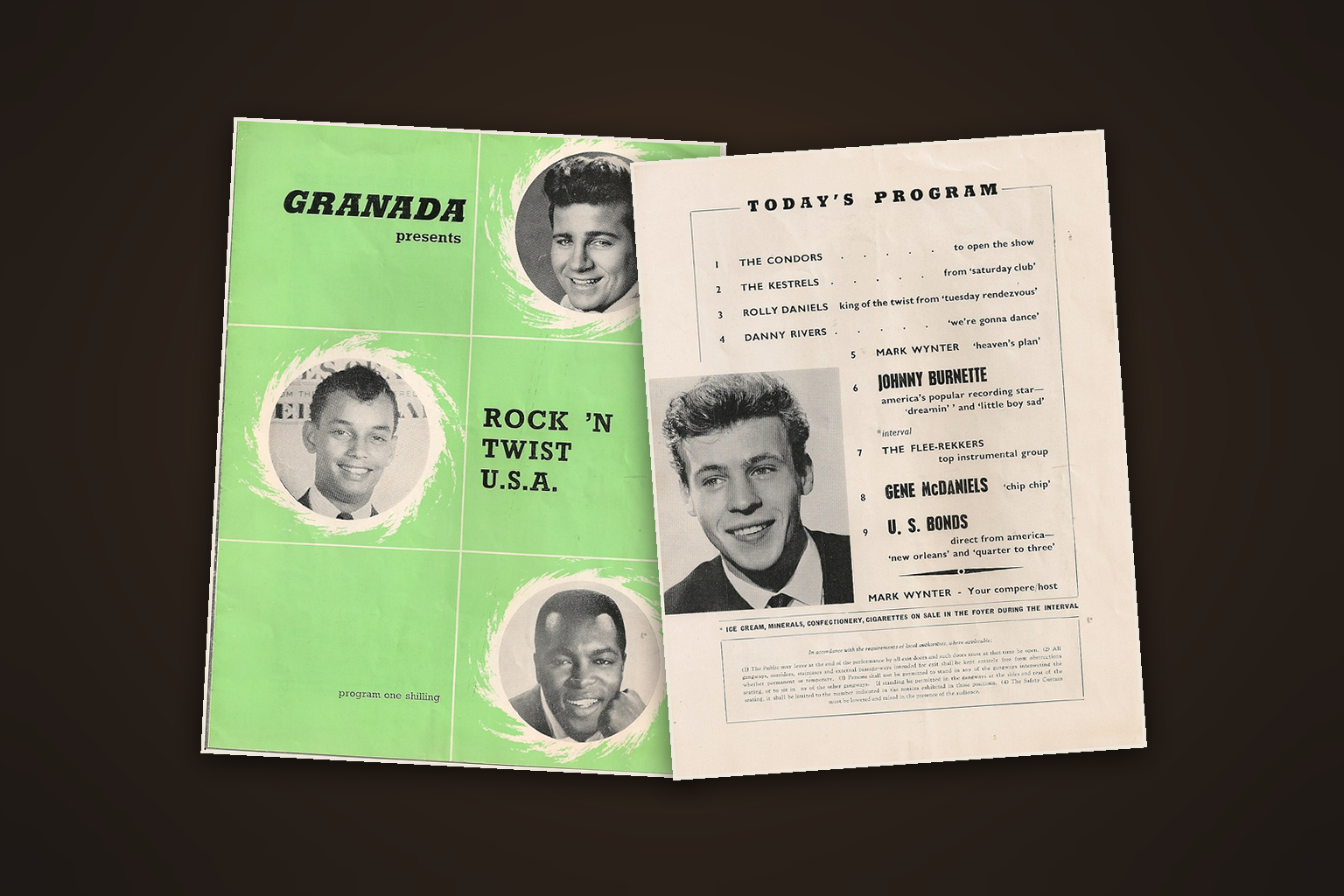
The programme cost a shilling. Its cover is lime green, with three circular photographs set in white brushstroke rings under the words GRANADA presents ROCK 'N TWIST U.S.A., and it prints the running order:
- 1. The Condors — to open the show
- 2. The Kestrels — from 'Saturday Club'
- 3. Rolly Daniels — king of the twist from 'Tuesday Rendezvous'
- 4. Danny Rivers — 'We're Gonna Dance'
- 5. Mark Wynter — 'Heaven's Plan'
- 6. JOHNNY BURNETTE — america's popular recording star, 'Dreamin'' and 'Little Boy Sad'
- interval
- 7. The Flee-Rekkers — top instrumental group
- 8. Gene McDaniels — 'Chip Chip'
- 9. U.S. Bonds — direct from america, 'New Orleans' and 'Quarter to Three'
Mark Wynter was the compere as well as the fifth act. Note the two songs printed under Burnette's name: "Dreamin'", two years old by then, and "Little Boy Sad", the one that had charted the previous April. A third, "Clown Shoes", entered the British chart on 23 May 1962 — ten days after the tour's closing night.
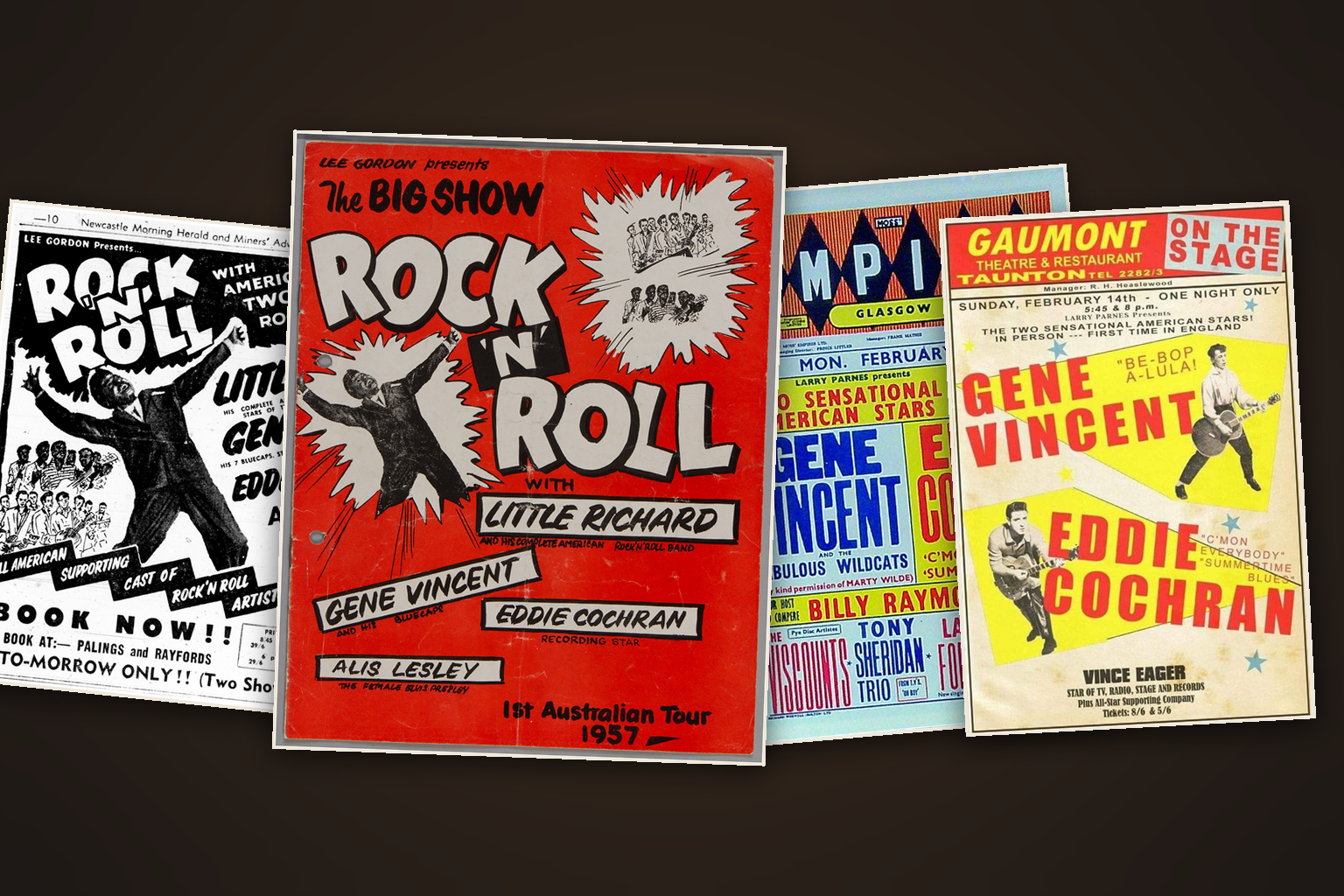
Note also where he sits: closing the first half. Two years earlier, on the same British circuit, the printed running order of Larry Parnes' Anglo-American Beat Show had put Eddie Cochran in exactly that position. Two surviving programmes, two American singers, the same place on the bill.
The itinerary
- 21 April — St Andrew's Hall, Glasgow. Opening night.
- 22 April — Hippodrome, Birmingham.
- 23 April — Guildhall, Portsmouth.
- 24 April — De Montfort Hall, Leicester.
- 25 April — Gaumont, Doncaster.
- 26 April — Gaumont, Worcester.
- 27 April — Colston Hall, Bristol.
- 28 April — Winter Gardens, Bournemouth.
- 29 April — Granada, Rugby.
- 30 April — Granada, Dartford.
- 1 May — Granada, Aylesbury.
- 2 May — Granada, Kingston.
- 3 May — Granada, Harrow.
- 4 May — Granada, Grantham.
- 5 May — Granada, Mansfield.
- 6 May — Granada, Tooting.
- 7 May — ABC, Plymouth.
- 8 May — Granada, Maidstone.
- 9 May — Granada, Bedford.
- 10 May — Granada, Kettering.
- 11 May — Granada, Woolwich.
- 12 May — Adelphi, Slough.
- 13 May — Granada, Walthamstow. Closing night.
Read it as a working diary rather than a schedule. Grantham on the Friday, Mansfield on the Saturday, Tooting on the Sunday, Plymouth on the Monday: Lincolnshire to Nottinghamshire to south London to Devon on four consecutive nights, in 1962.
August 1964
Two American trade weeklies reported Burnette's death in their issues of 29 August 1964, and they do not agree.
Cash Box, from Los Angeles, reports him killed "last week (14)" in a boating accident on Clear Lake: fishing with his family, his craft struck by another, knocked unconscious at the impact, thrown from the boat and drowned. It places his hits on Liberty and names a label of his own, Magic Lamp, for which he had cut "A Bigger Man".
Billboard, from San Francisco, has him drowning in a boating accident "Saturday (16)" at Clear Lake, and gives him a different new label, Sahara, and a different previous one, Capitol.
Same week, same death, three points of disagreement: the date, the label he had just founded and the label he had left. The Billboard notice does not agree with itself either — in 1964 the 14th of August was a Friday, the 15th a Saturday and the 16th a Sunday.
Rocky Burnette, his son, remembers only that his father was missing, and that "three or four days later they found his body." Asked since what happened, he has said: "Nobody ever talked to us about what exactly happened." Johnny Burnette was 30.
Dorsey turned to country music and died of a heart attack on 19 August 1979, aged 46. Paul Burlison went back to Memphis.
The name kept working without them
Burlison recreated the Rock and Roll Trio in the early 1980s with Johnny Black and Tony Austin, and Johnny's son Rocky Burnette fronted it on occasion. Burlison died on 27 September 2003. Bookings under the Burnette name therefore continue for decades after both brothers are dead, and they are not the same act. At Caister in November 1981 the souvenir programme billed the group as "The Johnny Burnette Trio with Rocky Burnette", alongside Frankie Ford and the Deltas.
A note on sources
- Dan Biggane, "Rock'n'Roll Heroes — Johnny Burnette", Vintage Rock, 6 December 2024, built on an interview with Rocky Burnette: the boxing connection, the Von single, the 1956 sessions, the Ricky Nelson doorstep, the family's account of Dorsey's departure, and Rocky's recollections of his father's death.
- The Official Charts Company for the five British chart entries and their peaks and dates.
- Contemporary Australian newspapers, from the National Library of Australia's Trove collection: the Brisbane Telegraph of 19, 20, 21, 24, 25, 27 and 28 April 1961 for the Brisbane concert and the bill; The Townsville Daily Bulletin and the Bundaberg News-Mail of 24 April 1961 for the Sydney arrival; and The Australian Women's Weekly of 3 and 17 May 1961. Trove's digitised holdings for April 1961 are dominated by Queensland titles, and no Victorian or South Australian paper of that month appeared in these searches, so the Melbourne, Adelaide and Sydney dates come from compiled itineraries rather than from advertising.
- Cash Box and Billboard, both 29 August 1964, and Billboard of 5 September 1964, consulted as page scans of the original issues in the World Radio History archive.
- American Rock n Roll — The UK Tours, `http://www.americanrocknrolluktours.co.uk/`, which draws on the book American Rock n Roll — The UK Tours 1956-1972, for the 1962 itinerary and the Flee-Rekkers as backing group.
- The 1962 souvenir programme, `GRANADA presents ROCK 'N TWIST U.S.A.`, from the Bradford Timeline collection on Flickr.
- Wikipedia, The Rock and Roll Trio, a tertiary source, for the Hideaway Club residency, the Crown Electric employment, the New York day jobs, the Ted Mack final, the GAC and Coral contracts, the Bob Thiele account of the guitar tone and the Niagara Falls account of Dorsey's departure.
- The loose-valve story about Burlison's amplifier is repeated in many places; no primary or first-hand source for it was found.