Eddie Cochran on the Road, 1955-1960
Eddie Cochran had about two and a half years as a name on a poster. Inside them he crossed the Pacific, worked a rolling American package of one-nighters, toured Britain in the variety manner of two houses a night, and died at twenty-one after a car crash on the A4 in Wiltshire.
The records are easy to find. The itinerary is harder, and it is the more revealing document: a working musician moving between a boxing stadium in Newcastle, New South Wales and a package-tour stage in the United States inside six weeks, billed each time in somebody else's typeface.
What follows is that itinerary read through the paper that survives it. Where the sources disagree, both versions are given. His American package dates have an article of their own: The Bus.
1955-1956: the Cochran Brothers and the television barn circuit
Cochran was born on 3 October 1938 in Albert Lea, Minnesota — not, as his publicity from 1957 onwards insisted, in Oklahoma City. Hold that thought; the story has a paper trail further down this page.
Before he was a solo act he was half of the Cochran Brothers with Hank Cochran, no relation, a hillbilly harmony duo signed to the small Ekko label in 1955. What the record holds for those years is regional television and scattered dates rather than a tour in any modern sense.
- 1955 — two hillbilly singles for Ekko and a run of dates that included the Big D Jamboree in Dallas. Hank Cochran's account is that a policeman at the Dallas venue told him about a singer called Elvis; the pair then travelled to Memphis and met Presley at a local radio station.
- January 1956 onwards — West Coast dates up through Oregon and Washington, and a regular spot on The California Hayride, the KOVR-TV show out of Stockton, California.
- 1956 — the Los Angeles country television circuit: Hometown Jamboree, Town Hall Party, California Hayride.
One of their songs from those days: Latch On.
The duo dissolved in 1956. That August Cochran filmed a two-minute spot for The Girl Can't Help It, singing "Twenty Flight Rock" in a rooming-house doorway, and it did what two years of jamborees had not.
October 1957: Lee Gordon's Big Show, Australia
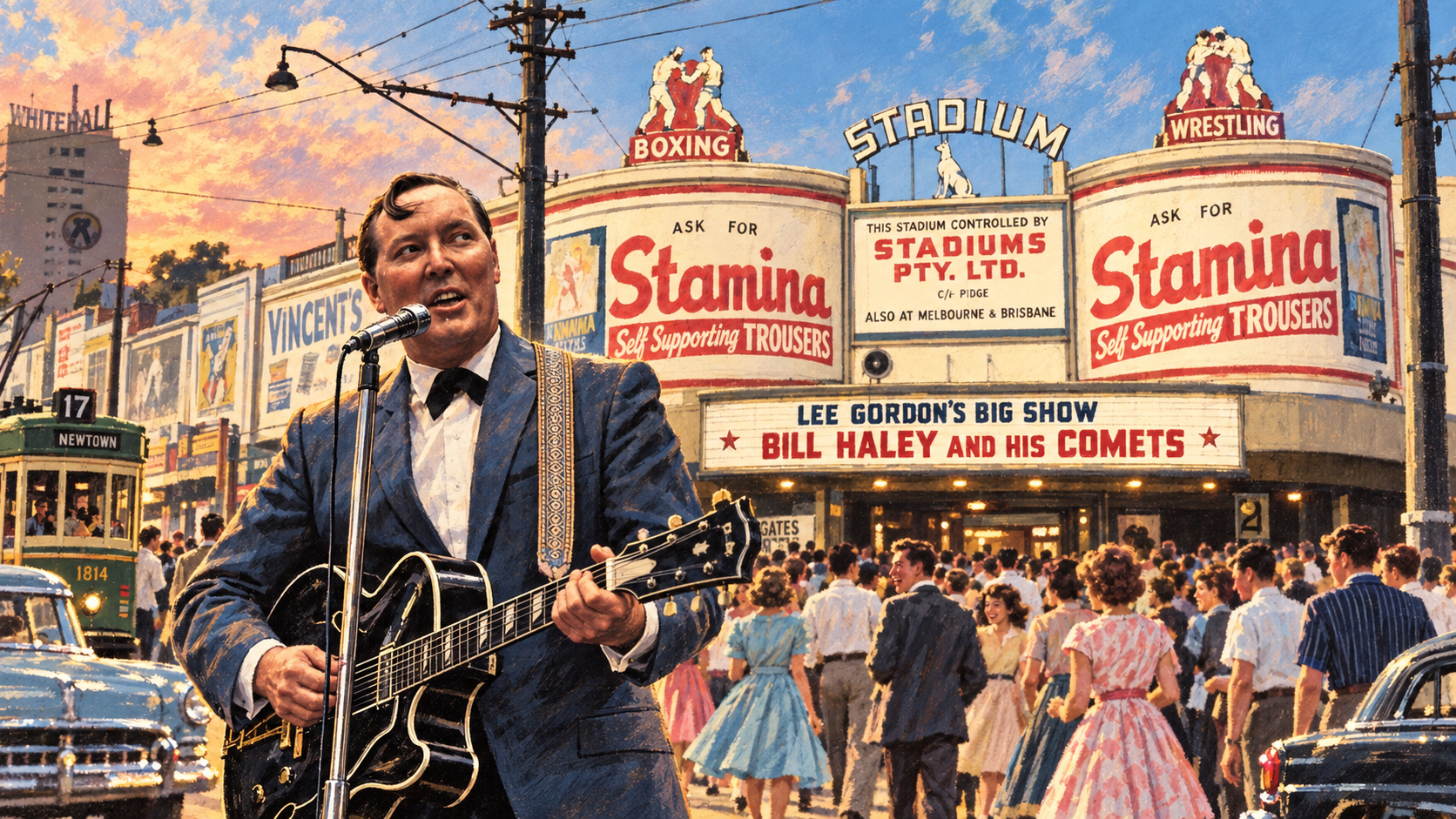
His first work outside the United States was in Australia. Promoter Lee Gordon put Little Richard, Gene Vincent and the Blue Caps, Cochran and Alis Lesley into a fortnight of Australian stadiums and theatres. Bobby Cochran, writing his uncle's biography in 2003, calls it "the first all rock 'n' roll extravaganza to visit Australia". The claim is his, and the contemporary papers complicate it: Gordon had brought Bill Haley and the Comets through the same stadiums in January of the same year, a company of twenty-two Americans advertised as The "BIG SHOW"; and The Argus was already advertising THE BIG SHOW at West Melbourne in October 1956.
It went wrong before it started. The Vincent party was offloaded at Honolulu airport, and accounts of why differ: the University of Newcastle's Hunter Living Histories project records that "some say because their papers were not in order, but others say that they were jettisoned because their behaviour was not up-to-scratch". Gordon engaged a young Sydney singer, Johnny O'Keefe, and his Dee Jays, and it was O'Keefe's band that backed the Americans — Cochran included, who had brought no band of his own.
What Cochran played is on the record. According to Bobby Cochran he sang his few Liberty singles and filled out the set with covers: Charlie Gracie's "Butterfly", "A White Sport Coat", and the country standard "Gone".
The dates
- 1 October — Crown Theatre, Wollongong, NSW. Two shows. Vincent and the Blue Caps missed this one.
- 2 October — Newcastle Stadium, Newcastle, NSW. Two shows, 6.00 pm and 8.45 pm.
- 3 October — Brisbane Stadium, Brisbane, QLD. Two shows, 6.00 pm and 8.45 pm.
- 4-5 October — Sydney Stadium, Sydney, NSW. Two shows on the 4th, three on the 5th.
- 6 October — Masonic Hall, Broken Hill, NSW. Two shows.
- 7 October — Wayville Stadium, Adelaide, SA.
- 8-10 October — West Melbourne Stadium, Melbourne, VIC. Two shows a night.
- 11 October — disputed. Contemporary advertising points to Newcastle Stadium, the compiled tour listings to Sydney Stadium, and one account has the Newcastle concerts cancelled outright; see below.
- 12 October — Sydney Stadium, Sydney, NSW. The last night of the tour.
- 13-14 October — two further dates advertised, and not played; see below.
Two shows a night, rings of seats around a boxing hall, a bill that ran barely ninety minutes: this was the Australian model Gordon was working.
Newcastle on 2 October left a contemporary report, quoted in Bobby Cochran's biography: "Screaming teenage admirers of an American Negro rock 'n' roll exponent, Little Richard, dragged him across the footlights and trampled him in a mob on the floor of Newcastle Stadium at the latest Big Show last night. It was rock 'n' roll night and one of the most riotous in the stadium's history."
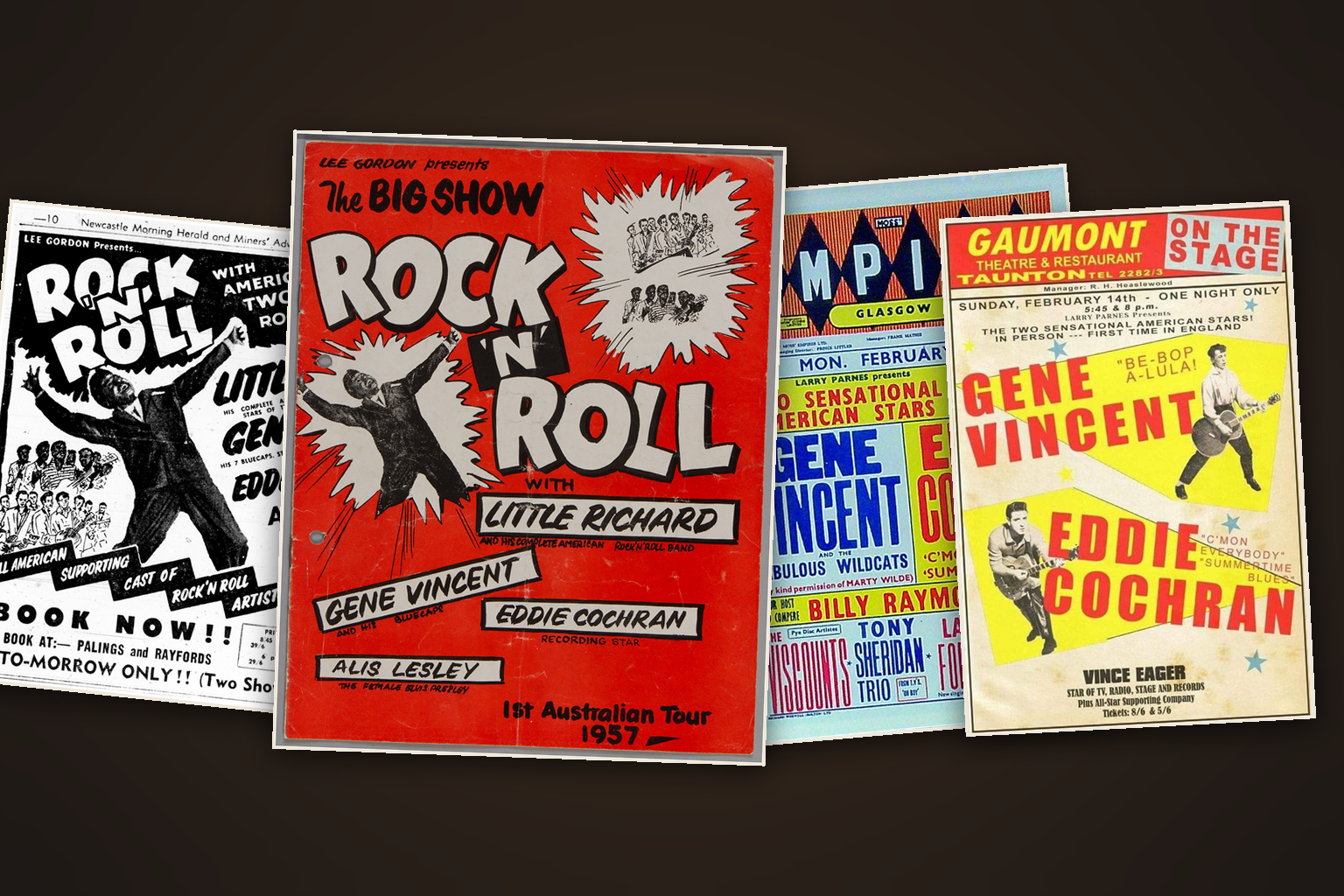
The advertisement: Newcastle Morning Herald, 1 October 1957
A detailed piece of graphic evidence for this leg survives, and it is not a poster but a newspaper advertisement. It repays reading closely.
Black ground, reversed-out white lettering. The words ROCK 'N' ROLL are hand-brushed, uneven, stacked on a diagonal and set into a jagged white starburst, with a halftone cut-out of Little Richard mid-leap bursting out of the explosion. The supporting names run down the right in heavy hand-lettered italic, each with a selling line underneath in small caps:
- LITTLE RICHARD — "his complete American 8 piece rock 'n roll band. Stars of the film 'The Girl Can't Help It.'"
- GENE VINCENT — "his 7 Bluecaps. Stars of the film 'The Girl Can't Help It.'"
- EDDIE COCHRAN — no strapline at all.
- ALIS LESLEY — "the female Elvis Presley."
Cochran is third down the column with nothing under his name. In October 1957 he had one American hit and no film credit being quoted in Australia. What the layout records is how the promoter chose to sell the bill; what anyone intended by it is not something the artwork can tell us.
Across the lower third, five black flashes set at angles read ALL AMERICAN / SUPPORTING / CAST OF / ROCK'N ROLL / ARTISTS!! Bottom left, BOOK NOW!! in gapped caps, "Book at: Palings and Rayfords", "To-morrow only!! (Two shows)". Bottom right, a price box — 8.45 pm: 39/6 and 29/6; 6 pm: 29/6 and 19/6 — beside a small solid-black logo block, THE BIG SHOW — NEWCASTLE STADIUM, over a scratchy line drawing of a band.
And in the right margin: YOU CAN DANCE! AT BOTH SHOWS — £25 each to best couple. A promoter in 1957 still thought it worth printing that you were allowed to get up.
The programme: "1st Australian Tour 1957"
The souvenir programme survives: twelve pages, staple-bound, 272 x 423 mm, printed by Publicity Press Pty Ltd of Regent Street, Sydney.
The cover is a single flat red with everything else in black and white. LEE GORDON presents sits small in the top left in brush caps, then The BIG SHOW in fat black hand lettering, then ROCK 'N' ROLL enormous, white with heavy black outlines, the "'N'" tipped into a black box. Two ragged white starbursts carry the images: a line drawing of a band top right, a leaping Little Richard photograph at the left, so the figure appears to punch through the cover. The names come in slanted white panels stacked down the lower half, each hand-ruled, each with a hand-lettered qualifier beneath — "and his complete American rock'n'roll band", "and his Bluecaps", EDDIE COCHRAN — RECORDING STAR, "ALIS LESLEY — the female Elvis Presley". Bottom right, angled up: 1st Australian Tour 1957.
That printed line matters for more than decoration. "The BIG SHOW" is this tour's own title on its own programme. Gordon used the phrase for years as a general description of his packages, and the Australian press used it the same way; but individual tours also carried titles of their own. The package he brought over in January 1960, with Duane Eddy at the top of the bill, was advertised as "The All-American Rock Spectacular" and described in the same weeks as the first Big Show of 1960. Both names are contemporary; they simply do different jobs.
Inside, Cochran gets a full page and a studio portrait, chin on fist. The biography opens: "Handsome young Eddie Cochran, whose initial recording on Liberty, 'Sittin' in the Balcony', was a national best-seller and catapulted him into the national spotlight, was born on October 3, 1938 in Oklahoma City, Oklahoma."
Right date, wrong state. It is the earliest appearance of the Oklahoma story in the printed matter examined here, and it turns up again in Britain three years later.
Friday 11 October: one date, three answers
On this day the sources do not merely differ in emphasis. They describe different events.
Somewhere in this fortnight Little Richard renounced rock'n'roll and threw his jewellery into the Hunter River. The date attached to that incident and the question of where the package played that night are the same question.
The researcher Roddy Jordan has the fullest paper trail, and it is a trail of a show being moved in a hurry. On 8 October the Sydney Morning Herald was still announcing two days of Sydney concerts, the 11th and the 12th. Then the Newcastle papers pick it up: advertisements in the Newcastle Morning Herald of 9 and 10 October and in the Newcastle Sun of 10 October, announcing that the show was returning to Newcastle on the Friday. Admission was a flat ten shillings for every part of the stadium, against the scaled 39/6 and 29/6 charged a week earlier. Jordan will not go further than the documents allow: on why it moved at all he writes that "we are unable to come up with the official reason why this concert was transferred from Sydney to Newcastle", and calls his own explanation, weak Friday bookings in Sydney, "only supposition on my part".
Against that sit two other positions. The compiled tour listings keep the package in Sydney for both nights: Jordan, who names The Big Beat of The Fifties (ARRAS) and the Eddie Cochran Connection among them, writes that every such account he checked has the concert in Sydney, and says flatly that it was not. And Roland Bannister, writing for the same Newcastle project as Jordan, remembers the opposite outcome entirely: that Little Richard "cancelled his second pair of Newcastle concerts about 48 hours before the advertised starting time – without notice, and without explanation", after advertisements had run in the Newcastle Herald on the Monday and the Wednesday before the Friday. Hunter Living Histories, for its part, dates the jewellery incident to 11 October in the title of its own chronology.
So the same Friday comes down to us three ways: a Sydney date, a Newcastle date that was played, and a Newcastle date that was abandoned. No contemporary review of a Newcastle concert that night has turned up in the material these researchers have worked through, which is why even Jordan cannot say for certain who was on the bill.
The closest thing to a primary witness is a letter from Johnny O'Keefe to Rick Pointon, dated 26 June 1978:
"Richard had been very pensive during the prior days about religious matters and when we arrived at the Stockton Ferry and the bus boarded the ferry, Richard in his own style of speaking said 'I'm quittin' show business and I'm going to serve the Lord'. Basie, his bass player remarked, 'If you're going to serve the Lord Richard, you should give away all your jewellery.' Just as soon as this had been said Richard peeled off his rings (most expensive ones) and his watch, opened the window of the bus and threw his possessions into the Hunter River."
O'Keefe adds that the show that night at Newcastle Stadium "was the best one that I ever saw."
A second O'Keefe account, published in Bob Rogers' Rock 'n' Roll Australia, tells the same story in a different order — and Jordan's reading is that O'Keefe "has got his two visits to Newcastle mixed up", putting the Melbourne Sputnik episode after the river rather than before it. The eyewitness and the documentary record disagree about sequence, which is worth saying rather than smoothing over.
Little Richard's own later accounts have placed the rings variously in the Hunter, off "Carrington Bridge", off a Sydney ferry and off Sydney Harbour Bridge. The later tellings do not agree on a location.
The two dates that were advertised and not played
A Brisbane Courier Mail article of Friday 11 October 1957 announced two more concert days — Melbourne on Sunday 13 October and Brisbane on Monday 14 October — described as charity performances, and an advertisement of 9 October named Little Richard and Gene Vincent at Brisbane Stadium. The touring party flew home on 13 October. Jordan's researcher searched the Melbourne papers and trade press across 8–18 October and found nothing either advertising or cancelling the Melbourne date.
What is not in dispute: Sputnik went up on 4 October, mid-tour; Little Richard preached from the stage in Melbourne instead of singing; Australian dates were abandoned; and he flew home to train for the ministry. Jordan adds a caution worth carrying: between the party's arrival on 28 September and the second Melbourne concert on 9 October he could find no newspaper report of Richard declaring that the world was ending.
1957-1958: the American bus
Three days after the last Sydney show, Cochran walked onto the stage of the Shrine Auditorium in Los Angeles and into the Biggest Show of Stars for '57 — a rolling package of one-nighters that had been running since 6 September. He was not on the opening bill: three acts left it on 15 October and Cochran, Buddy Knox and Jimmy Bowen joined, and for the next six weeks Cochran travelled in the smaller type under Fats Domino, Chuck Berry, Buddy Holly and the Crickets, and the Everly Brothers.
He did it again in January 1958, on "America's Greatest Teenage Recording Stars", which opened in Charlotte on the 8th and closed at the Jefferson County Armory in Louisville on the 24th.
Those two tours, the cast changes and the window card that advertised them are a story of their own: The Bus: Eddie Cochran and the Feld Package Tours, 1957-1958.
1958-1959: the records, the television, the films
- Summer 1958 — "Summertime Blues" is recorded and released.
- November 1958 — American Bandstand and The Dick Clark Show, performing "C'mon Everybody".
- 7 February 1959 — Town Hall Party, the Saturday-night show broadcast from a Compton theatre dressed as a barn. The filmed performance survives: "C'mon Everybody", "Summertime Blues", "School Days", "Money Honey". In the interview he says he expects to be in Santa Barbara the following Friday and then to work his way up and down the coast and back East.
- 1959 — Go, Johnny, Go!, his third film, still billed in British programmes the next year under its working title "Johnny Melody".
1960: Britain
Gene Vincent arrived in Britain in December 1959 to headline Boy Meets Girls, and impresario Larry Parnes went looking for a second American. Cochran flew into London Heathrow on 10 January 1960, rehearsed on the 12th and 13th, and was on British television on the 16th and again on the 23rd.
The package Parnes built around the two of them was billed as "A Fast Moving Anglo-American Beat Show"; the theatre programmes shorten it to "A Fast Moving Beat Show". It ran in the variety manner: two houses a night, six nights in a week at the big Empires and Hippodromes, the local orchestra playing the overture.
The billing, as printed:
- Gene Vincent — "Rock 'n' Roll idol of millions"
- Eddie Cochran — "First time in Britain"
- Billy Fury — "Britain's newest teenage idol"
- Georgie Fame — "New singing pianist"
- Joe Brown — "From TV's 'Boy Meets Girl'"
- Tony Sheridan Trio — "From TV's 'Oh Boy'"
- Billy Raymond — "Compere and star of HMV records"
Backing was by the Wildcats, Marty Wilde's band, loaned to the tour: Big Jim Sullivan and Tony Belcher on guitars, Brian "Liquorice" Locking on bass, Brian Bennett on drums. Three of those four went on to the Shadows or to the London session circuit, and Sullivan's account of the tour is that Cochran could pick up any instrument on stage and demonstrate the part he wanted.
The 1960 itinerary
- 24 January — Gaumont, Ipswich. 5.30 and 8.00, with Vincent and Vince Eager.
- 28 January — Gaumont, Coventry. 5.30 and 8.45.
- 29 January — Gaumont, Worcester. Two houses.
- 30 January — Gaumont, Bradford. 6.00 and 8.15.
- 31 January — Guildhall, Southampton. 3.00 and 8.15.
- 1-6 February — Empire, Glasgow. Six nights, 6.25 and 8.40, with the Viscounts, the Tony Sheridan Trio, Lance Fortune and Sally Kelly, compered by Billy Raymond.
- 7-12 February — Gaumont, Sheffield. Six nights, 5.30 and 8.00.
- 13 February — Granada, Woolwich, London.
- 14 February — Gaumont, Taunton. 5.45 and 8.00, tickets 8/6 and 5/6.
- 18 February — De Montfort Hall, Leicester. Two houses.
- 19-20 February — Boy Meets Girls television recordings.
- 20 February — Caird Hall, Dundee. 6.15 and 8.45.
- 21 February — Empire Pool, Wembley. The NME Poll Winners Concert.
- 24 February — Globe, Stockton-on-Tees. 6.15 and 8.30, with Vince Eager and the Quiet Three. Seats 7/6 down to 3/-.
- 26 February — Gaumont, Cardiff. 6.25 and 8.40, with Vince Eager and the Quiet Three.
- 29 February - 5 March — Empire, Leeds. Six nights, 6.00 and 8.15.
- 5 March — BBC radio, Saturday Club.
- 7-12 March — Hippodrome, Birmingham. Six nights, 6.20 and 8.30.
- 14-19 March — Empire, Liverpool. Six nights, 6.20 and 8.30.
- 21-26 March — Empire, Newcastle upon Tyne. Six nights, 6.15 and 8.30.
- 28 March - 2 April — Hippodrome, Manchester. Six nights, 6.25 and 8.40. Vincent collapsed on stage on the 29th and was replaced on the 30th by Peter Wynne.
- 4-9 April — Finsbury Park Empire, London. Six nights, 6.25 and 8.40.
- 11-16 April — Hippodrome, Bristol. 6.25 and 8.40, closed Good Friday.
The theatres' own posters correct the compiled tour listings in three places: Stockton and Cardiff carried Vince Eager and the Quiet Three, not Billy Fury or Joe Brown, and Manchester and Bristol played at 6.25 and 8.40 rather than 6.20 and 8.30.
By the Bristol week the American half of the bill had thinned: Dean Webb, Peter Wynne, Georgie Fame, the Tony Sheridan Trio and Billy Raymond around Vincent and Cochran.
The programme, and the running order
The Birmingham Hippodrome programme for the week of 7 March survives as a complete scan, and it shows how the show was built and how it was sold.
The cover is not a rock'n'roll cover. It is the house cover: matt black, with the word VARIETY across the top in fat brush lettering, each letter alternating yellow, red and white, the dot of the "i" replaced by a red scribbled loop. Below it, a yellow line drawing of a chorus line and a yellow banner cut at an angle carrying "At the HIPPODROME BIRMINGHAM" in a sober serif. Along the bottom: PROGRAMME PRICE SIXPENCE. Two American rock'n'roll stars were being sold inside a house style designed for jugglers and soubrettes.
The centre spread carries the running order, printed in red and black with a harlequin mask and a scroll of musical staves in the corners, a boxed MONDAY, MARCH 7th on the left page and a boxed ONE WEEK ONLY on the right, "LARRY PARNES presents / A Fast Moving Beat Show" across the gutter.
First half:
- 1. Overture — The Empire Orchestra
- 2. Billy Raymond — your host and compere
- 3. Tony Sheridan Trio — From TV's "Oh Boy"
- 4. Joe Brown — From TV's "Boy Meets Girl"
- 5. Billy Raymond introduces — "For the first time in England, EDDIE COCHRAN, Hit Recorder of 'C'mon Everybody' and 'Summertime Blues'"
Then: INTERMISSION — THE HIPPODROME ORCHESTRA.
Second half:
- 6. Georgie Fame — New Singing-Pianist
- 7. Billy Fury — Britain's Newest Teenage Idol
- 8. Billy Raymond — Star of H.M.V. Records
- 9. Gene Vincent — "The Rock 'n' Roll Idol of Millions, backed by the fabulous Wildcats (by kind permission of Marty Wilde)"
Under the last line, in small caps: FULLY LICENSED BARS IN ALL PARTS OF THE THEATRE.
Cochran closes the first half; Vincent closes the show; the compere gets his own spot at number eight; and the local pit orchestra plays the interval. This is a variety bill with rock'n'roll inside it.
Cochran's own page runs a studio portrait beside publicity copy worth quoting for what it gets wrong: "Twenty year old, Oklahoma-born Eddie Cochran has been playing the guitar since he was six years old." It explains that his ambition to sing dated from a shooting accident that "put a bullet in his leg" and put him in hospital for months, and closes with a Personal Note: "Eddie owns 65 sweaters, collects guns, is a keen movie goer, and drives a shooting brake in preference to a flashy sports car."
Oklahoma again, three years and two continents on from the Sydney programme. He was twenty-one by then, too.
And the programme's own estimate, printed as such: "It has been estimated that already Eddie Cochran has travelled 28,000 miles on concert tours, and has played before more than 3,000,000 people."
16-17 April 1960
The last show was the Saturday house at the Bristol Hippodrome on 16 April. The compiled tour listings disagree about that week — some give the 11th to the 14th and the 16th, others simply book six nights — but the theatre's own poster settles it in three words printed under the showtimes: CLOSED GOOD FRI. There was no performance on Friday 15 April.
Cochran wanted to go home for a few days. A private-hire Ford Consul was booked to take him, Gene Vincent, tour manager Patrick Tompkins and his fiancée, the songwriter Sharon Sheeley, to London Airport. At about 11.50 pm, on the A4 at Rowden Hill, Chippenham, Wiltshire, the nineteen-year-old driver, George Martin, lost control and the car hit a concrete lamp post.
Cochran was in the centre of the back seat. He threw himself across Sheeley. He was taken to St Martin's Hospital in Bath with severe head injuries and died there at 4.10 pm the following afternoon — Easter Sunday, 17 April 1960. He was twenty-one. Sheeley and Vincent survived; Vincent's already-damaged leg was broken again. The driver was convicted of dangerous driving, fined £50 and disqualified for fifteen years.
The tour did not stop. On 30 April it played the Gaumont, Hanley, with Jerry Keller in Cochran's place; on 1 May the Gaumont, Lewisham; on 3 May Liverpool Stadium. "Three Steps to Heaven" reached number one in Britain on the chart dated 23 June 1960, with its singer already buried.
What the paper shows
Read the artefacts in sequence and a shape appears in how he was sold.
In Sydney in 1957 he is a name in a slanted white box, third down, captioned RECORDING STAR, on a red cover built around somebody else's leap. In Birmingham in 1960 he closes the first half of a variety bill, on a cover that says VARIETY in the same lettering it used for the chorus line.
Those are facts about the printing. What the promoters meant by them is not recorded on the artwork, and the artwork is what survives.
Open questions
- Whether the package played Newcastle or Sydney on Friday 11 October 1957, and whether Little Richard appeared. Jordan's advertisements make a documented case for Newcastle; Bannister records a cancellation on the same day; no contemporary review of that night has surfaced in the newspapers either researcher searched.
- Whether Gene Vincent was on the bill for that Newcastle date. Three Newcastle witnesses say he was, and no press account of that concert turned up in the newspapers either researcher searched.
A note on sources
- The Australian programme: The Big Show — Rock 'n' Roll, 1st Australian Tour 1957, Lee Gordon, printed by Publicity Press Pty Ltd, Regent Street, Sydney. Twelve pages, 272 x 423 mm. The copy consulted is a photographic scan of an archival original; its holding collection is not identified on the scan.
- The Newcastle advertisement: Newcastle Morning Herald and Miners' Advocate, Tuesday 1 October 1957, page 10.
- Bobby Cochran, Three Steps to Heaven: The Eddie Cochran Story (2003) — source for Cochran's Australian repertoire, for the "first all rock 'n' roll extravaganza" description and for the Newcastle riot report quoted above.
- The O'Keefe letter: Johnny O'Keefe to Rick Pointon, 26 June 1978, reproduced courtesy of Rick Pointon in "Little Richard Newcastle", Hunter Living Histories, University of Newcastle, 6 May 2019.
- Roddy Jordan, The Full Story of a Rock 'n' Roll Tour Australia – 1957, chapters "The Eighth Show — Newcastle (2), Friday 11th October 1957" and "The Missing/Cancelled Concerts", hosted as PDFs by Hunter Living Histories at the same article.
- Roland Bannister, "Bop Bopa-a-lu a Whop Bam Boo! How Little Richard Made Rock and Roll History in Newcastle", published in the same Hunter Living Histories article.
- Bob Rogers, Rock 'n' Roll Australia – The Australian Pop Scene 1954-1964, for the second O'Keefe account.
- The Birmingham Hippodrome programme, week of Monday 7 March 1960 — consulted as the complete photographic scan in the Bradford Timeline album 1960 - Gene Vincent & Eddie Cochran, `https://www.flickr.com/photos/bradford_timeline/albums/72157627051431036/`, which also carries the tour's dated itinerary, its billing and its running order.
- The British itinerary is assembled from that Bradford Timeline listing and from American Rock n Roll — The UK Tours, `http://www.americanrocknrolluktours.co.uk/`, which draws its itineraries from the book American Rock n Roll — The UK Tours 1956-1972; it lists the same twenty-one engagements and books the Bristol week as "11-14 & 16 April", independently of the theatre's poster. Corrections to the support bills at Stockton and Cardiff and to the Manchester and Bristol showtimes come from photographs of the theatres' own posters, as noted in the text. The same archive is the source for the dates the tour played after Cochran's death.
- Ken Burke, "Eddie Cochran", Contemporary Musicians (Gale), consulted at `https://www.encyclopedia.com/education/news-wires-white-papers-and-books/cochran-eddie` — for the Ekko signing, for the Big D Jamboree in Hank Cochran's own words, for the meeting with Presley at a Memphis radio station, and for the Los Angeles television programmes.
- Ace Records, Eddie Cochran: The Early Years, `https://acerecords.co.uk/the-early-years` — for the Ekko singles and for the Presley show the duo saw in Dallas.
- Graham Pugh, The Truth About Eddie Cochran: The Oklahoma City Connection, `http://www.eddiecochran.net/` — a research project drawing on Cochran's birth certificate, Oklahoma City directories and school records, the Freeborn County Museum at Albert Lea and interviews with family, including Bobby Cochran. Source for the Albert Lea birth, for the January 1956 run to Oregon and Washington, for KOVR-TV's California Hayride, and for the filming of the Girl Can't Help It cameo on 14 August 1956. The site serves over HTTP only.
- The Official Charts Company, Official Singles Chart dated 23 June 1960, `https://www.officialcharts.com/charts/singles-chart/19600623/7501/` — for "Three Steps to Heaven" at number one.
- Wikipedia, Eddie Cochran, `https://en.wikipedia.org/wiki/Eddie_Cochran` — retained as a tertiary source for the sequence of the crash itself on 16-17 April 1960: the Ford Consul and its occupants, the time, Rowden Hill, the driver's age, St Martin's Hospital, the time of death and the sentence. No contemporary press report, inquest record or court report for those details was located in this search.