
Crazy Cavan 'n' the Rhythm Rockers: Teddy Boy Rock'n'Roll Out of Newport
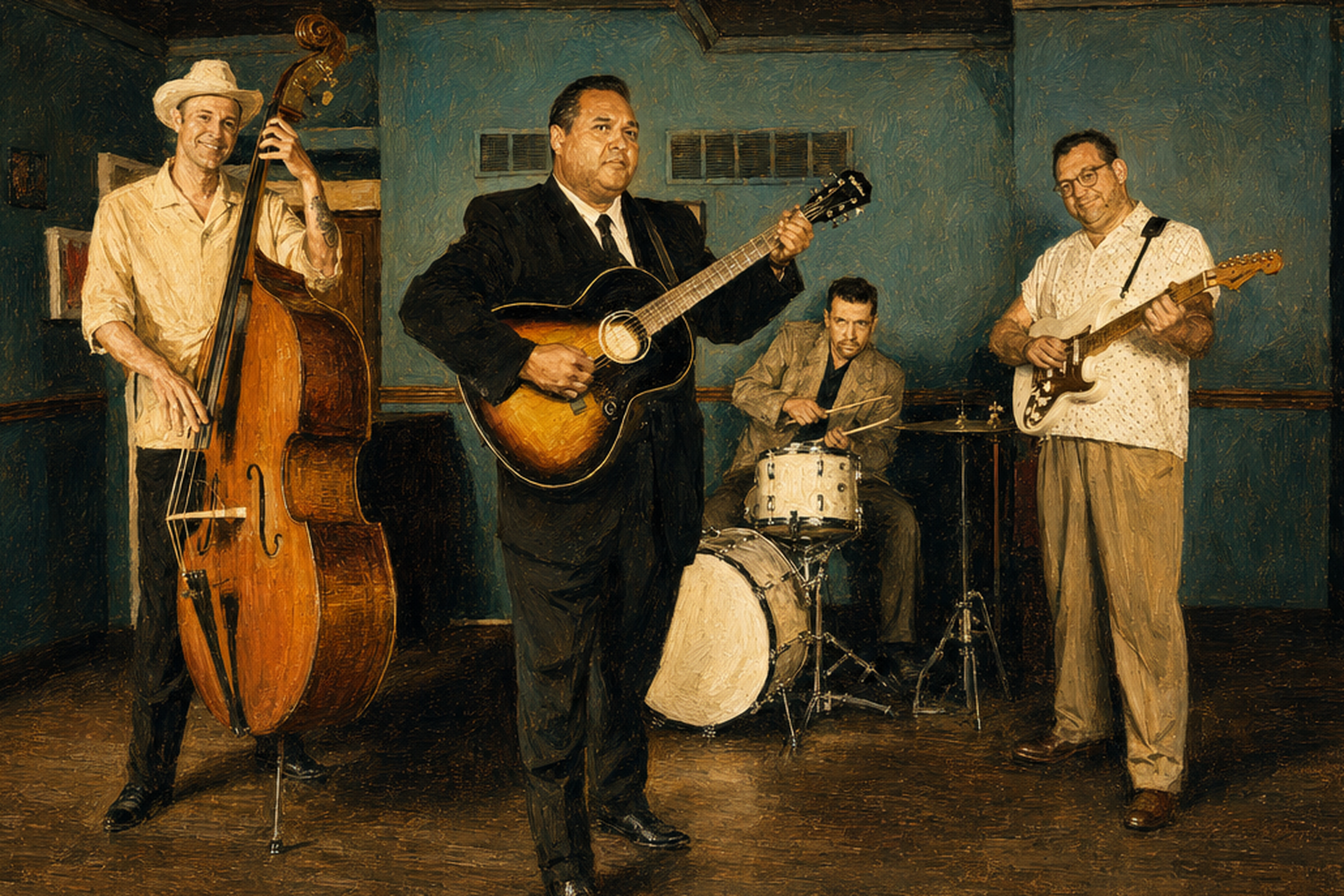
Newport, South Wales, in the middle sixties. The dance halls belonged to the beat groups; five teenage Teddy Boys started a band and played rock'n'roll anyway.
Crazy Cavan 'n' the Rhythm Rockers did not have chart records. What they had was a repertoire of their own songs, a label of their own, and an audience that dressed the way they did. The music writer Douglas McPherson, in an obituary of the band's singer, puts the reason plainly: Cavan Grogan "was the first songwriter to write about the clothes and culture of those distinctly British post-war youth cults, the drape-coat-wearing Teddy Boys and the leather-clad rockers".
This is how that happened.
Before the name, there was a vampire
The band's own history page describes the early sixties from the inside: to say the words "rock 'n' roll" as a teenager then "brought scorn", the dance halls belonged to the beat groups, and Teddy Boys were "labelled along with the Greasers and the Ton-up boys as 'Rockers'". So five teenage Teddy Boys from Newport played it themselves.
Cavan Grogan was born in February 1949 and spent his early childhood in County Mayo before his family moved to South Wales. He had found rock'n'roll at seven, in 1957, through the Elvis film Loving You, and was young enough to watch it vanish from the radio before he reached his teens.
The first band, with Grogan, Lyndon Needs on lead guitar, Needs' cousin Terry Walley on rhythm guitar and Gerald Bishop on drums, was called Screamin' Count Dracula and the Vampires. It did not last, and the reason is almost too neat: they were too young, and none of them had a driving licence.
The group that followed was The Sundogs. From here the sources stop agreeing about dates. The band's own history page puts the formation at 1964 and then says that "in 1968 Cavan, Lyndon and Terry teamed up with wild boogie piano player Brian Thomas and bass player Don Kinsella, as 'The Sundogs'" — but the same page, a few lines later, says that "when in 1970 this band was joined by Don Kinsella and Mike Coffey it was the start of 'Crazy Cavan and the Rhythm Rockers'". McPherson's account gives a third version: the line-up was "completed by bassist Don Kinsella and drummer Michael Coffey" by the end of the sixties.
What all three agree on is the outcome. By 1970 the drummer was Mike Coffey, the bass player was Don Kinsella, and the name was the one that stuck.
Part of the fuel came from a Newport collector, "Breathless" Dan Coffey — the drummer's elder brother, and editor of the fanzine Boppin News. He was, McPherson writes, one of the first British collectors to travel to Memphis and ship rare and forgotten rockabilly back into Britain. The band's own history page says he had been importing "hundreds of rare, mostly unreleased, and up till then unheard of Rockabilly records out of the USA into Newport".
That is the whole advantage in one sentence. As the DJ Geoff Barker puts it: "When they went up to London, all the other rock'n'roll bands were doing all the standards like Be Bop-A-Lula and Whole Lotta Shakin' Goin' On, and Cavan didn't do any of that. They were doing all this rare rockabilly that hadn't been released in England."
1973: the first records, on their own label
For four years they worked semi-professionally, playing what they called "crazy rhythm": rockabilly, rock'n'roll and country pushed through a Welsh amplifier. Their reputation went national, Barker says, after they played the First Ever British Rock'n'Roll Festival at Alexandra Palace in 1973, on a bill headlined by Screaming Lord Sutch. "That really kick-started them, because there were people there from all over the country saying, 'Who's this band? Where did all these songs come from? Who's this Charlie Feathers and Mac Curtis that they're talking about?' No one had heard of those artists at the time."
By the end of 1973 they were making records, and they made them themselves: the label was their own, and they called it Crazy Rhythm.
- 1973 — debut single "Teddy Boy Boogie" backed with "Bop Little Baby", Crazy Rhythm CR 01.
- 1974 — the four-track EP "Teddy Boy Rock 'n' Roll", Crazy Rhythm CR.02: "Teddy Boy Rock 'n' Roll" and "Rockabilly Star" on one side, "Wildest Cat In Town" and "My Little Teddy Girl" on the other.
- 1975 — first album, "Crazy Rhythm", released not in Britain but in the Netherlands on Rockhouse (7510).
- 1976 — "Rockability" on Charly Records (CRL 5001).
- 1978 — "Live At The Rainbow", cut at the Rainbow Theatre in London.
- 1979 — "Still Crazy", back on their own imprint, Crazy Rhythm CRLP 01.
March 1975 is the night the band themselves mark as the turning point. Their history page records it as a landmark: top of the bill at the Lyceum in London, with fans travelling "hundreds of miles" for it. That is the career in one image. Not a chart position — a room full of people who came a long way.
The Charly deal put them with the producer John Schroeder, who had worked with Status Quo, and with Joop Visser, the man who had picked up the British rights to Hank Mizell's "Jungle Rock". Barker's view of why the records never charted points at the label rather than the band: Charly, he says, was primarily an oldies operation, and "I don't think they had another contemporary band". That is his reading, offered as such.
They wrote their own songs, and that is the point
Barker's account of the London bills has a second half to it. The other bands played the standards; Crazy Cavan played the rare rockabilly, and then they played their own songs — written, as McPherson puts it, about the clothes and the culture they had come up in.
Five of them:
- "Teddy Boy Boogie", the 1973 debut single.
- "My Little Sister's Got A Motorbike".
- "Rockabilly Star" and "Wildest Cat In Town", both first issued on the 1974 EP and carried over onto the album the following year.
- "Rockabilly Rules Ok!", a title that reads like graffiti because it is.
Barker locates the difference exactly there: "They were unashamed Teds, they appealed to the Ted audience and they wrote about Teddy Boy culture. No one else had ever done that."
The scene came with them
The audience came dressed as the band dressed, and it travelled to do it: the band's own account of the March 1975 Lyceum bill has fans arriving from hundreds of miles away.
There is film of it. The 1980 documentary "Blue Suede Shoes" caught the revival at a 1979 weekender in a Norfolk holiday camp, with Crazy Cavan on the bill alongside Matchbox, the Flying Saucers, Freddie Fingers Lee and Ray Campi. They played the first Caister weekender in March 1979, which is the same scene at the same moment.
The generation behind them was listening. Boz Boorer, whose band the Polecats reached the charts with "Rockabilly Guy" in 1981, first heard Crazy Cavan on records belonging to his first drummer's older brother — "He was a Ted and was older than us" — and first saw them at the Orange Tree in north London.
15 February 2020
Their last show with Cavan was the 37th Rockers Reunion in Reading, on 18 January 2020.
Four weeks later, on 15 February 2020, Cavan Grogan died. He was 70, three days short of his 71st birthday. The South Wales Argus carried the family's tribute, describing him as "an inspiration"; WalesOnline headlined its report with the name the scene already used for him — Newport's original rock'n'roll rebel.
Fifty years, from a school-age band with nobody old enough to drive to a man still closing festivals a month before he died.
The band did not stop
After Cavan's death the band returned for a one-off tribute show in Newport with his son Joe Grogan singing. It sold out, and they kept going, still with Lyndon Needs on lead guitar, still booked across Europe.
In January 2026 they headlined the 43rd Rockers Reunion in Aldershot, billed as Crazy Cavan's Rhythm Rockers with Joe on vocals. A month later, on 20 and 21 February, they played two memorial nights at the Corn Exchange in Newport, in the town where the thing started, in the same week of the year that he died.
It has not been an easy few years. On 2 July 2026 the band announced the death of their bass player Graham Price, who had taken over from Don Kinsella in the mid-seventies. The notice on their own front page is signed "Lyndon, Terry, Mike and Joe".
Selected recordings
A note on sources
- The band's official site, `http://www.crazycavan.com/` — its History page for the early line-ups, the "Boppin News" connection, the Lyceum in March 1975 and the Charly signing; its front page for the announcement of Graham Price's death on 2 July 2026. The site serves over HTTP only.
- Douglas McPherson, "Crazy Cavan: A Rockabilly Star In Heaven", Vintage Rock, 7 July 2020 — for Grogan's birth and childhood, Loving You, the Needs–Walley family connection, Dan Coffey's role, and the quotations from Geoff Barker and Boz Boorer.
- South Wales Argus, "Family pays tribute to Newport music legend Cavan Grogan", and WalesOnline, "Newport's original rock 'n' roll rebel Crazy Cavan Grogan has died", both February 2020.
- Discogs, artist 1238327, for the release dates, labels, catalogue numbers and the 1974 EP tracklist. Note that a plain search for "Crazy Cavan" returns a different, near-empty artist entry first.